

The Nameless Freight
Look at an ordinary wooden ferry pulling away from the bank in the falling light.
The crossing is rarely dramatic. A passenger argues over the fare; a vendor balances two empty cane baskets on his knees; a young mother reaches out to pull a toddler back from the wet edge of the boat. Beside them, someone else sits quietly on the damp bench, staring down at the dark seams in the timber.
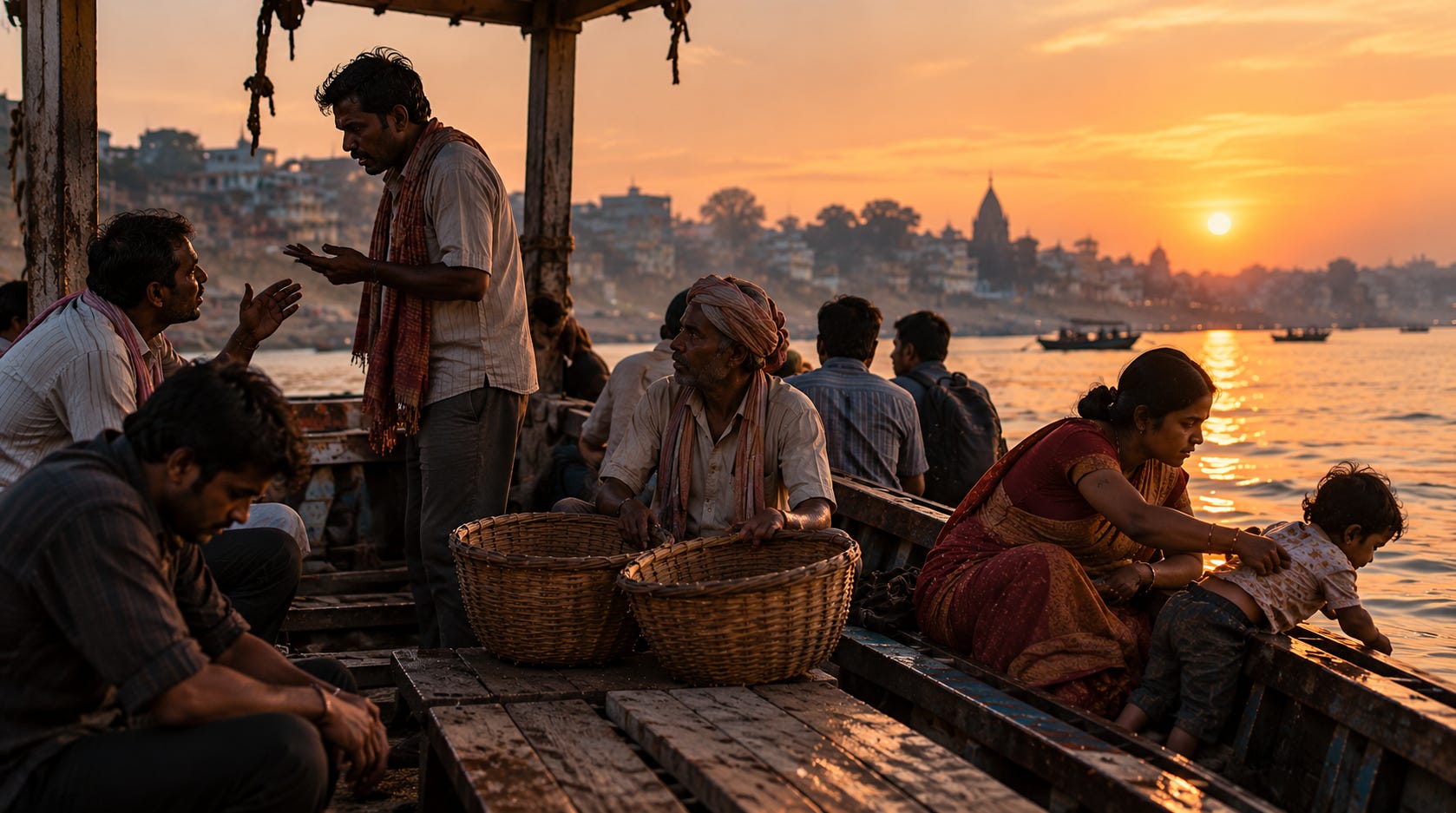
It is easy to imagine that everyone aboard is nursing an invisible tragedy. In truth, most passengers are simply tired, calculating household expenses, or wondering what is waiting on the stove at home. But in any gathering of strangers, there is often someone who has stepped outside the reach of ordinary conversation.
In the opening chapter of the Bhagavad Gita, Arjuna’s collapse does not begin with silence. He speaks at length. He catalogues the physical symptoms of his dread. His trembling limbs, burning skin, and dry throat… and constructs elaborate, reasoned arguments about familial duty, social breakdown, and ritual ruin. He can explain the predicament from every angle, yet his analysis changes nothing. By the opening verses of the second chapter, he confesses that his nature has been overcome by weakness (कार्पण्यदोषोपहतस्वभाव: ... | 2.7) and that his mind is bewildered about duty.
Arjuna’s crisis reveals a difficult truth: suffering does not always stay hidden because words are missing. Often, a person has explained the ache a hundred times, rehearsed the defense, argued the logic until the voice is hoarse, and still finds no way forward. The boundary of language is reached not only by those who cannot speak, but by those who discover that no arrangement of words can make the weight bearable.
How many came to the water’s edge
with things they could not speak or name?
The Crowd of Strangers
A few feet from the engine housing, a man rehearses an apology he knows he will never make. Across the deck, an elderly woman adjusts her cotton shawl, carrying news she has not yet figured out how to tell her daughter.
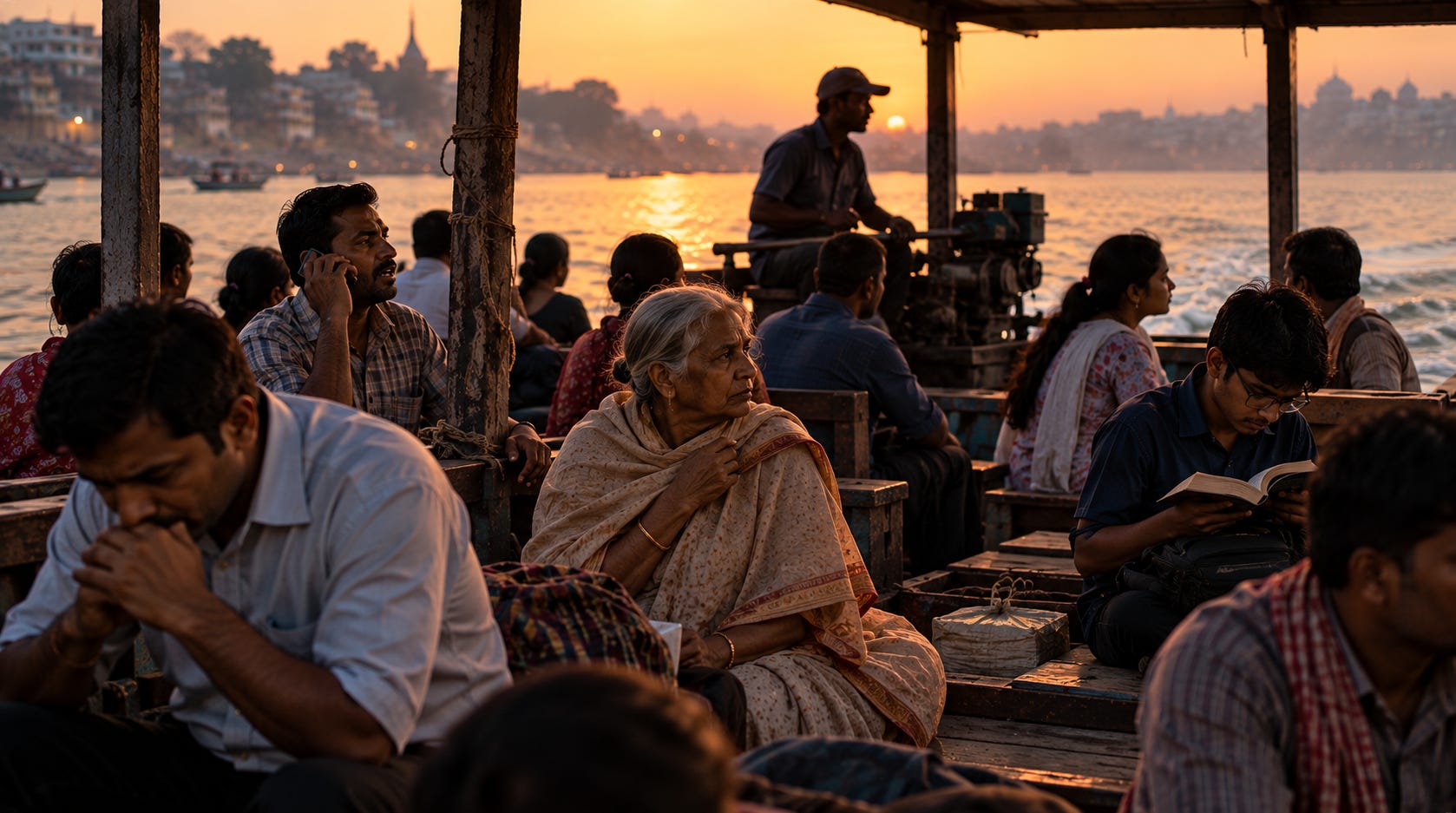
Between the person talking loudly on a mobile phone and the student reading a textbook, ordinary life continues. Society demands and rewards that visibility. We build institutions around public titles, legal contracts, family obligations, and civil decorum. But we have almost no social room for the experiences that fail to fit those forms: a devotion that had to remain unacknowledged, an irreparable mistake made in private, or the quiet, steady failure of a life’s primary hope.
In the second chapter of the Gita, Lord Krishna speaks to the broader mystery of embodiment: अव्यक्तादीनि भूतानि व्यक्तमध्यानि भारत | 2.28 - beings are unmanifest in their origin, manifest in the intervening period, and unmanifest again after death.
Lord Krishna’s verse is a metaphysical reflection on birth and mortality, not a psychological theory of secrecy. Yet it opens a quiet, metaphorical space: even during this brief middle stretch where human lives are visible, how small a portion of anyone’s existence do we actually witness?
We see the fare being handed over, the wet shoes, the parcel balanced on a lap. What remains submerged is not always concealed out of caution. Sometimes there is simply no place for it in the ordinary transactions of the day. The boat carries them all across. What each person is carrying remains largely unknown to the others.
How many stood among the crowd,
bearing a grief without a claim?
The Wordless Address
Near the prow, a passenger leans over the railing, dips fingers into the cold water, and presses them against their forehead. There is no spoken chant, no Sanskrit verse, no offering of sweetmeats.
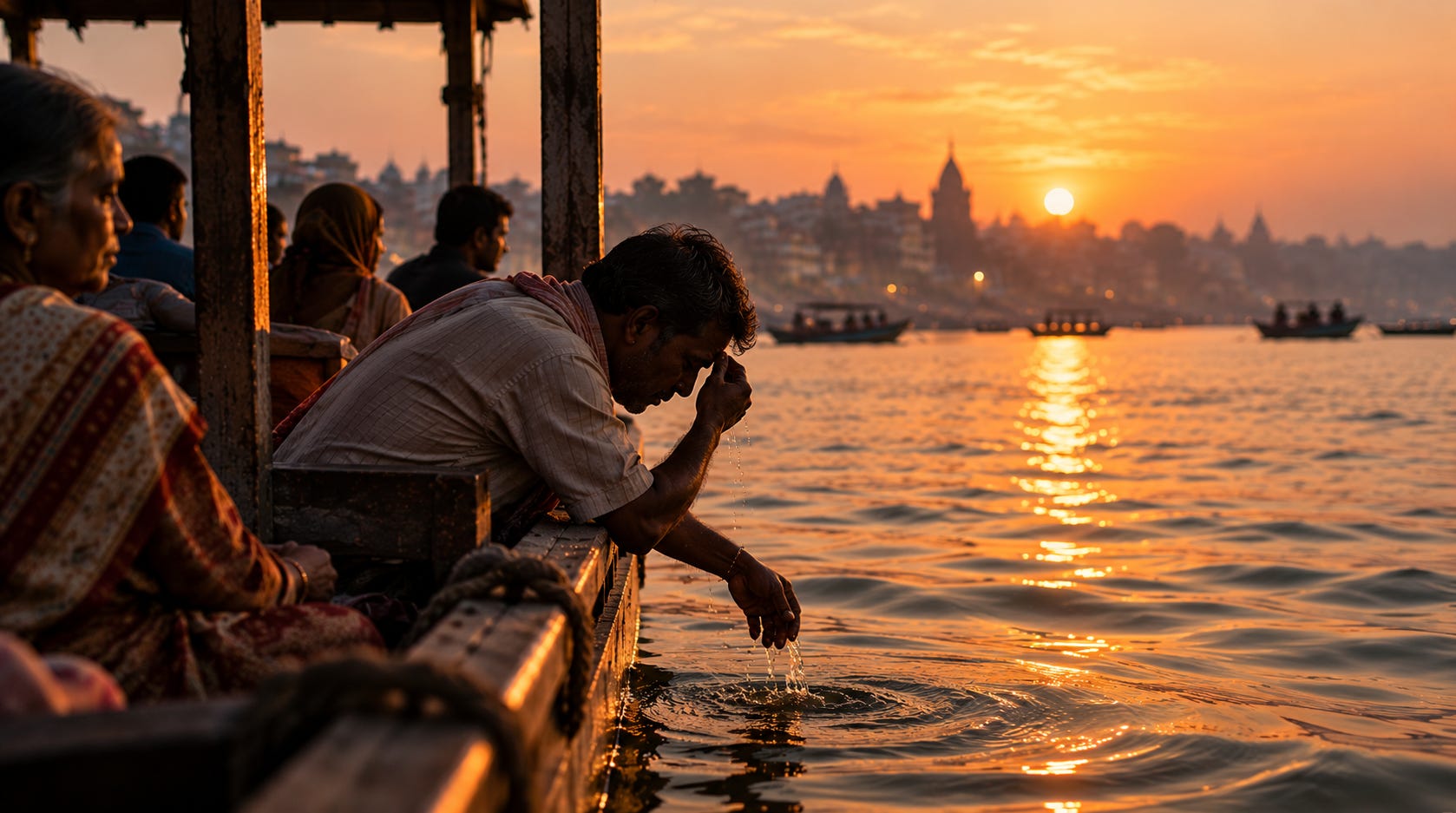
In the seventh chapter of the Gita, Lord Krishna identifies four kinds of virtuous seekers who turn toward the divine (चतुर्विधा भजन्ते मां जना: सुकृतिनोऽर्जुन | 7.16): the distressed (आर्त), the seeker of knowledge (जिज्ञासु), the seeker of material gain (अर्थार्थी), and the wise (ज्ञानी).
It is telling that the distressed appear first. Affliction does not wait for a refined vocabulary. Some people find solace in magnificent poetry or intricate philosophy; others find that when a crisis strikes, the mind empties of every formal phrase it ever memorized.
The Gita later offers a companion verse in Chapter 9, where Krishna remarks that whether one offers a leaf, a flower, a fruit, or even a little water (पत्रं पुष्पं फलं तोयं यो मे भक्त्या प्रयच्छति | 9.26), it is received if offered with devotion. The significance does not lie in the material splendor of the ritual, nor in the rhetorical polish of the plea. Perhaps that is what remains when speech runs dry: not a perfected prayer, but the possibility that a small, sincere gesture may still be enough.
Some folded hands without a word,
some had forgotten how to pray.
What the Water Keeps
The engine cuts to an idle as the wooden bow bumps against the mud and stone of the opposite shore.
The Gita uses a famous comparison in its second chapter to describe the disciplined mind: आपूर्यमाणमचलप्रतिष्ठं समुद्रमाप: प्रविशन्ति यद्वत् | 2.70 - just as the waters of all rivers enter an ocean that remains full and undisturbed, so one who is disciplined finds peace amid the influx of desires. The comparison concerns inward equanimity, not emotional indifference or a promise that nature will dissolve our sadness.
The river does not offer a rescue. Stepping off the ferry does not heal an illness, erase a debt, or return the dead. The water is entirely indifferent to the moral worth of the passengers; it provides neither forgiveness for an unspoken crime nor validation for a silent love.
What it offers during the crossing is something much sparser: a brief, neutral interval between two banks. On the chariot of Kurukshetra, Lord Krishna’s teaching did not make the opposing army disappear, nor did it spare Arjuna the pain of battle. The circumstances remained, but Arjuna was asked to understand his duty, his attachments, and the action before him differently.
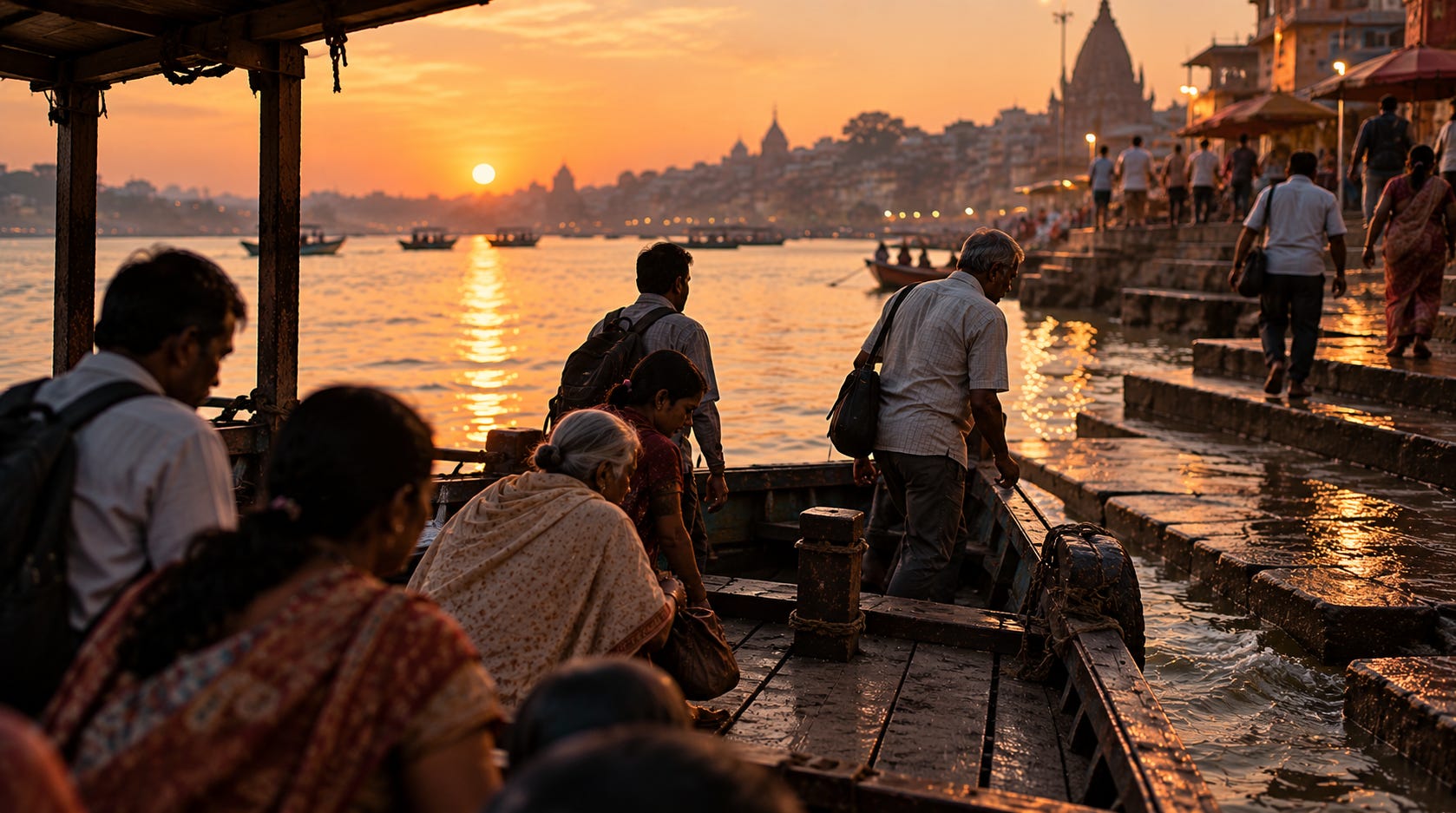
Some people cross the water hoping to leave a sorrow behind; others step ashore knowing they must pick it up again on the other side. The river receives neither their explanations nor their excuses. It simply bears the vessel through the dark, indifferent and unhurried, while the passengers step back into the street to resume their lives.
The river made no promises,
nor asked what they had come to say.
The realization that people can explain an ache a hundred times and still find no way forward because language hits its limit is profound. Watching strangers carry unvoiced apologies and unspoken news across the water makes for a truly moving read. Thank you for writing this.