


I have spent nearly thirty years watching the sky over Odisha, and for most of my life, the weather kept its promises.
There was an unspoken calendar coded into the rhythm of our lives. You accepted that May would be brutal, baking the red earth and bleaching the asphalt. But you bore it because you knew that by the second week of June, the first dark monsoon clouds would roll in from the Bay of Bengal, smelling of drenched dust and relief. By mid-September, the rain would soften. By October, the skies would clear into a gentle, washed indigo, the sweet scent of Gangasiuli blossoms would cling to dawn air, and by the time Kali Puja arrived, you would pull a light cotton shawl from the steel almirah for the evening scooter ride.
That rhythm has fallen completely out of step.
Living through 2026 has felt less like enduring a bad turn of weather and more like watching a familiar landscape slowly lose its mind. It is now late October in Bhubaneswar. As I write this on Vijaya Dashami, with Durga Puja drawing to a close, the ceiling fans still whir relentlessly at top speed, air conditioners groan through the night, and stepping out onto Janpath at noon feels like opening an oven door.The chill that used to mark this time of year has entirely vanished. Instead, we are caught in a sweltering, airless greenhouse where the heat refuses to die, punctuated only by erratic deluges and cyclonic depressions that crash ashore before dissolving into yet another wave of suffocating humidity.
Is this the future we were warned about? Because standing in the middle of it, it no longer feels like a distant scientific projection printed on glossy climate summits. It feels like our everyday reality unspooling in real time.
The New Summer: Beyond the Thermometer
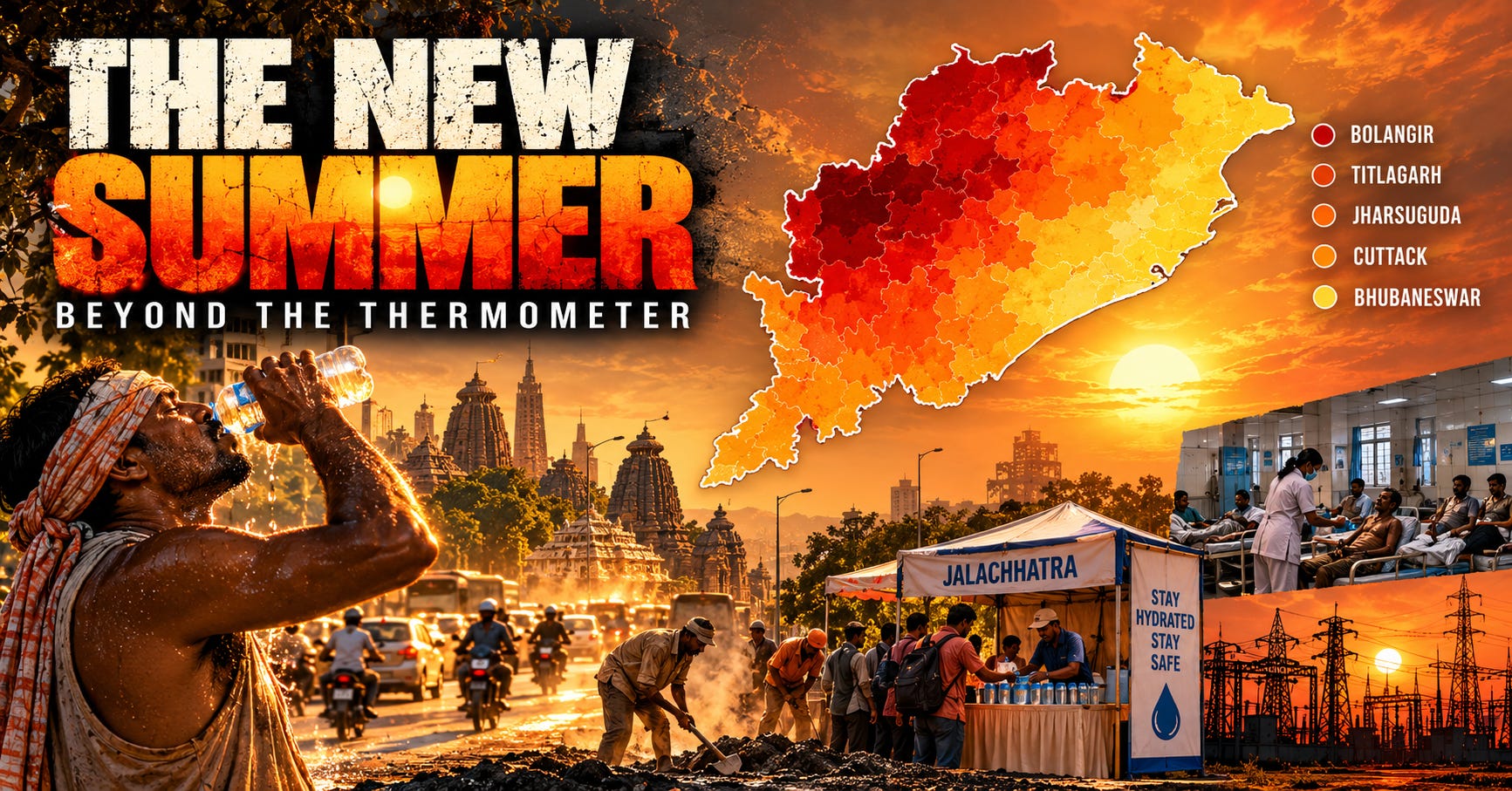
The transformation begins months earlier in what has become an unendurable summer cauldron. Historically, extreme heat in Odisha belonged to the western hinterlands. We expected Titlagarh, Bolangir, and Jharsuguda to flirt with 45°C or 47°C - those rocky, arid belts where the afternoon wind feels like dry fire. But recent seasons have rewritten the geography of heat.
The coastal belt, anchored by Bhubaneswar and Cuttack, was traditionally moderated by the marine influence of the sea. That buffer has eroded. When temperatures in the twin cities routinely push past 44°C and brush 45°C, they collide with high coastal humidity. This produces lethal wet-bulb conditions, a state where the air is so saturated with moisture that sweat cannot evaporate from the skin.
On the streets, you feel the physical danger of that shift. Walking past Rajmahal Square or Master Canteen during midday, the heat radiates off concrete towers, glass frontages, and tarred highways that store warmth long after sunset. The city has become an intense urban heat island. In local hospitals and community health centres across Khurda and Cuttack districts, the casualty wards see a steady stream of acute heat exhaustion, severe dehydration, and electrolyte crashes. It is a quiet crisis that hits the daily-wage labourer, the Zomato delivery boy, the traffic constable, and the street vendor, those whose livelihoods do not allow them the luxury of staying indoors between eleven in the morning and four in the afternoon.
The administrative response has become an annual ritual of triage: Jalachhatras (water kiosks) set up under canvas awnings, free ORS packets handed out at bus stands, adjusted morning shifts for schools, and formal advisories restricting outdoor manual labour during peak hours. Yet, as the mercury soars, the power grid stumbles under the historic cooling load. Sub-stations trip, transformers blow, and the hum of backup diesel generators fills residential colonies, trading temporary indoor relief for more trapped outdoor heat.
The Broken Monsoon and the October Humidity Trap

If the summer were the only problem, Odisha could perhaps endure it. After all, endurance is something our people have practiced for generations. The deeper, more disorienting horror is what happens after the summer ends.
The monsoon timetable has broken down. The long, continuous, life-giving monsoon spells that used to nourish the coastal delta have been replaced by erratic, violent mood swings. We now swing between prolonged rainless dry spells that bake standing paddy and sudden, localized cloudbursts that dump days worth of precipitation in a matter of hours. The agrarian calendar, built around the delicate timings of sowing, tilling, and transplantation, is thrown into complete disarray.
And then there is the Bay of Bengal, simmering under elevated sea-surface temperatures. Just weeks ago, late in the season, the coastal alerts sounded once again. A deep depression gained cyclonic momentum over the water, tracking toward the south Odisha and north Andhra coastline. For days, news tickers flashed yellow and orange alerts for Koraput, Gajapati, and Ganjam. Thousands of families in landslide-prone hamlets and low-lying river basins had to be evacuated into cyclone shelters as gale-force winds tore down branches and torrential rains triggered flash floods across southern river catchments.
We know how to manage evacuations; the state has built a formidable reputation for disaster response since the 1999 Super Cyclone. But what used to be a distinct seasonal hazard has become an unpredictable, year-round vulnerability. Cyclonic disturbances no longer just announce the onset or exit of seasons; they batter the coast and leave behind stagnant water, ruined vegetables, and high atmospheric moisture that the sun immediately turns into a boiling soup.
That brings us to October - what used to be the most gentle month in the Odia calendar.
Instead of autumn, we now live through an unbearable “second summer.” After the recent storm cleared, the skies opened up into a blinding, harsh blue, and the residual moisture from saturated soils evaporated straight into the air. The thermometer may show 34°C, but the heat index routinely registers perceived temperatures near 41°C.
You walk outside in the evening expecting the crisp, drying breeze that used to carry the festive sounds, only to find your collar soaked with sweat within ten paces. The air is stagnant, heavy, and exhausted. Winter is missing in action. Decades ago, morning dew would glisten on the grass of Ekamra Kanan and the chill off the Kuakhai River would make you pull your sleeves down. Today, that cold front has been pushed back deeper into the calendar, shrinking the winter window into a fleeting, mild fortnight in January.
The natural world is just as confused as we are. The seasonal migrations to Chilika Lake arrive late to find water bodies still uncomfortably warm. Forest tracts in Similipal that should be lush and damp are drying out faster, shortening the recovery window before the next fire season begins. The seasonal cues that guided birds, trees, and farmers for centuries have simply stopped functioning.
The Policy Shift: From Storm Shelters to Thermal Sanctuaries
For decades, Odisha’s disaster policy was forged in the memory of howling coastal winds and tidal surges. We built concrete cyclone shelters, honed early-warning radar systems, and trained specialized rapid-action forces to move millions of people to safety within forty-eight hours. We became world leaders at running away from the storm.
Heatwaves and seasonal breakdowns, however, cannot be solved with an evacuation bus. You cannot evacuate four crore people from the sun.
This creeping crisis demands an entirely different administrative posture, one that shifts away from temporary emergency fixes toward permanent, structural climate adaptation.
The state government has taken necessary initial steps with its Heat Action Plans, deploying district-level emergency advisories, setting up public cooling spaces, and enforcing work halts for unorganized labourers during heat peaks. But a policy built on distributing drinking water and shifting school hours is merely applying a bandage to an amputated limb.

The real transformation must happen in how we plan our living spaces, manage our waters, and protect our soil:
Public health systems need an immediate, climate-responsive upgrade. Primary health centres in semi-urban and rural blocks cannot continue operating with poorly ventilated asbestos roofs and unreliable power lines. They must be re-engineered as decentralized thermal sanctuaries, equipped with solar-backed micro-grids, climate-controlled stabilization rooms, and dedicated medical protocols to treat heat-induced renal stress and cardiovascular strain before patients collapse.
In urban centers like Bhubaneswar and Cuttack, planning authorities must call an immediate halt to the mindless paving of open ground. The frantic drive to turn the capital into a sleek metropolis has stripped away native banyan and neem canopies in favor of ornamental shrubs, concrete medians, and reflective glass facades that trap radiant heat. We need legally enforced cool-roof mandates, extensive green-corridor retrofitting, and absolute protection for our remaining water bodies and natural drainage systems like Gangua Nala, which are currently being suffocated by construction debris. A city that replaces its wetlands with apartment complexes is a city building its own crematorium.
In agriculture, the state must aggressively subsidize the transition toward climate-resilient farming. Relying entirely on water-intensive, heat-sensitive paddy varieties is an economic death sentence when monsoons arrive as sudden floods followed by four-week dry spells. Farmers need access to heat-tolerant native seeds, micro-irrigation infrastructure that conserves depleting groundwater, and decentralized crop insurance schemes that compensate them not just when a cyclone submerges their fields, but when unseasonal October heat rots the crop before it can be threshed.
Energy architecture must also evolve. Relying on centralized coal-fired power stations to supply an explosion of summer air-conditioning demand is an unsustainable loop that accelerates the very emissions driving the crisis. Rooftop solar mandates for commercial and residential buildings, decentralized community micro-grids, and underground utility cabling that withstands cyclonic gusts are no longer ambitious urban luxuries; they are essential survival infrastructure.
Is This What We Were Warned About?

Those of us who grew up here carry a ghost map in our minds, a memory of an Odisha where the seasons moved like clockwork, where the Mahanadi breeze actually cooled the evening ghats, and where the transition from rain to cold was a gentle, reliable passage of time.
That map is no longer valid. The lines have blurred into a continuous, exhausting cycle of prolonged heat, erratic rain, and lingering humidity.
When scientists decades ago talked about climate change, it was easy to dismiss it as an abstraction… a graph of parts-per-million, melting polar ice caps, or sea-level rises that would bother someone else, somewhere far away, long after we were gone.
Now, look out your window in Bhubaneswar this October. Feel the air that refuses to cool, listen to the forecast tracking yet another low-pressure system spinning over an overheated bay, and watch the sweat pool on your skin under a night sky that should have brought a chill.
This is not a dress rehearsal. We can continue treating each scorching summer, ruined crop, and delayed winter as an unlucky accident, or finally recognize that the climate we built our lives around is gone.
Is this what survival looks like now? Is this the new baseline?