

(Author’s Note: The opening scene and the encounter in Section ‘The Mirror of Stone’ are presented as literary reconstructions - meditations drawn from the familiar rhythms and ritual landscape of Varanasi rather than documented reportage.)
The Woman and the River
The old woman had been sitting on the stone steps of Dashashwamedh Ghat for nearly an hour.
Around her, Varanasi was assembling its nightly conversation with the divine. Young priests in gold-trimmed silk laid out their tiered brass lamps across wooden platforms lashed together above the river silt. Conch shells rested beside bundles of dried camphor; hand-turned brass bells gleamed under the rising flare of tall sodium fixtures; and the Ganga moved through the dark below with the unhurried indifference of water that had received the ashes, sewage, prayers, and garlands of more generations than the city cared to count.
The woman had brought nothing elaborate. No brass thali, no priests to shape her grief into the metre of classical Sanskrit, no heavy garlands bought from the stalls near the chowk. She held only a small earthen cup containing a wick soaked in oil, three wilting orange petals, and a sorrow she had evidently carried far longer than the oil had been burning.
She leaned forward, her spine curving with the patient slowness of age, and lowered the little flame toward the water.
Her lips moved slightly.
Nobody standing on the steps beside her could hear what she whispered. Perhaps she was speaking to an absent son who had stopped returning calls from a distant factory town. Perhaps to a husband whose final prescription had sat unfilled on a tin trunk because the money ran out. Perhaps she was asking to be pardoned for an unkind word spoken in a courtyard forty years ago, or perhaps she had no transaction to propose at all… only an inner ache for which ordinary speech had become useless.
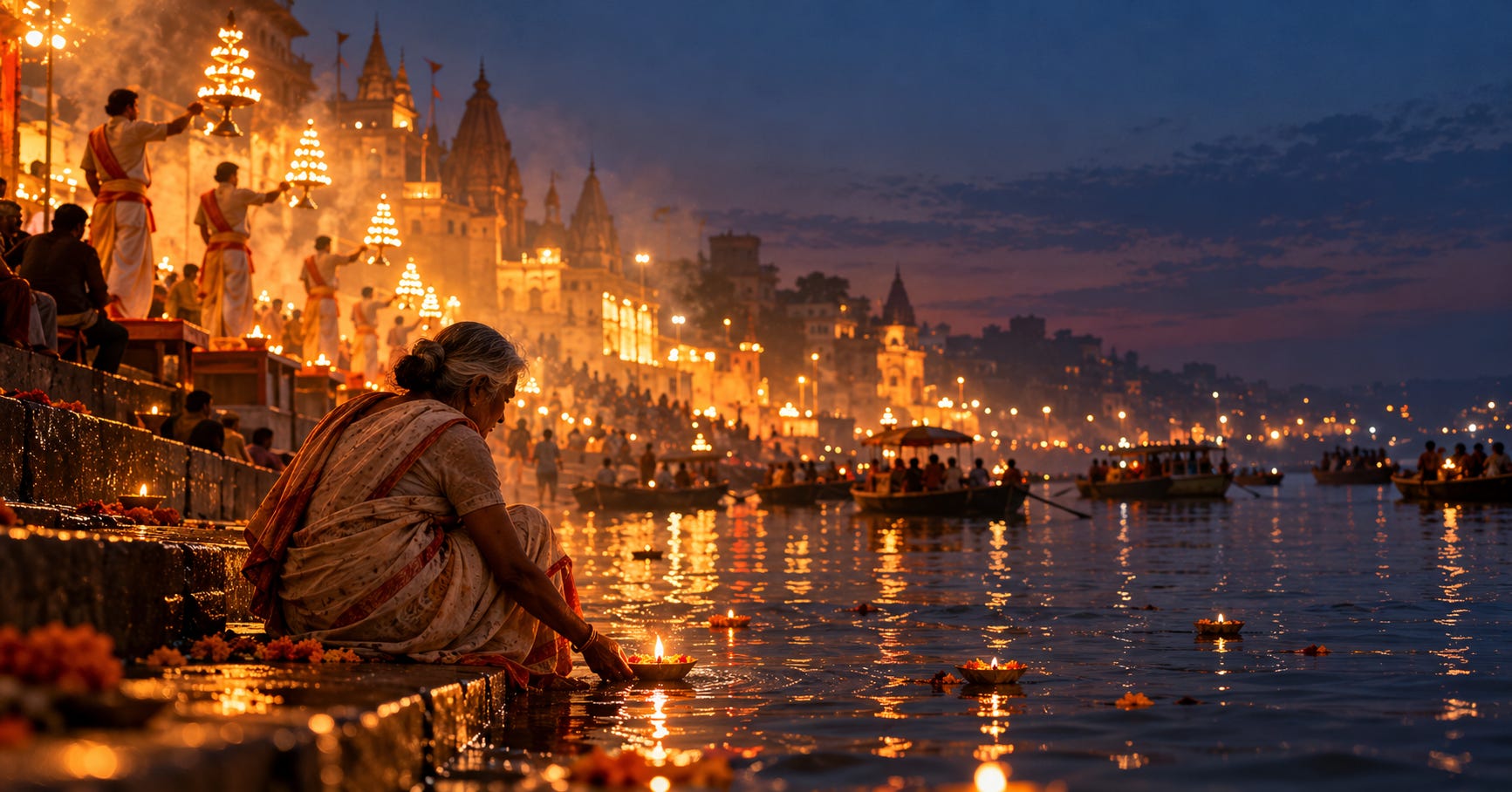
The river offered no sign. The current caught the bottom of the terracotta dish, turned it once in the silt-heavy eddies, and bore the light out into the dark channel where the tourist boats had not yet ventured.
The woman remained on the wet stone, her bare feet tucked beneath the hem of her coarse cotton saree, looking out into the unlit space beyond the opposite bank. She did not weep, nor did she cross her hands in formal prostration. She simply stayed, motionless, staring into the dark as though she were waiting.
What was she waiting for?
Not an audible reply; the sane do not expect the night sky to clear its throat. Not a sudden suspension of natural law; she knew her joints would still throb when she climbed the steep alley toward Godowlia.
Perhaps she was waiting to believe that something was listening.
Not necessarily someone.
Not an emperor seated upon a cosmic lotus, keeping a ledger of small indiscretions; not an ancient mother whose affection could be bartered for five rupees’ worth of flowers; not even an intellect that shared our biological categories of sorrow or design.
Simply something.
A reality with an interior. A ground of being that possesses a capacity to receive, so that human experience - its terrors, its secret loyalties, its unrecorded dignities, does not occur inside an empty vault.
The Terror of the Cosmic Form
It is an ancient longing, and its most dramatic counterpoint is recorded not in peaceful temples, but in the middle of an impending war.
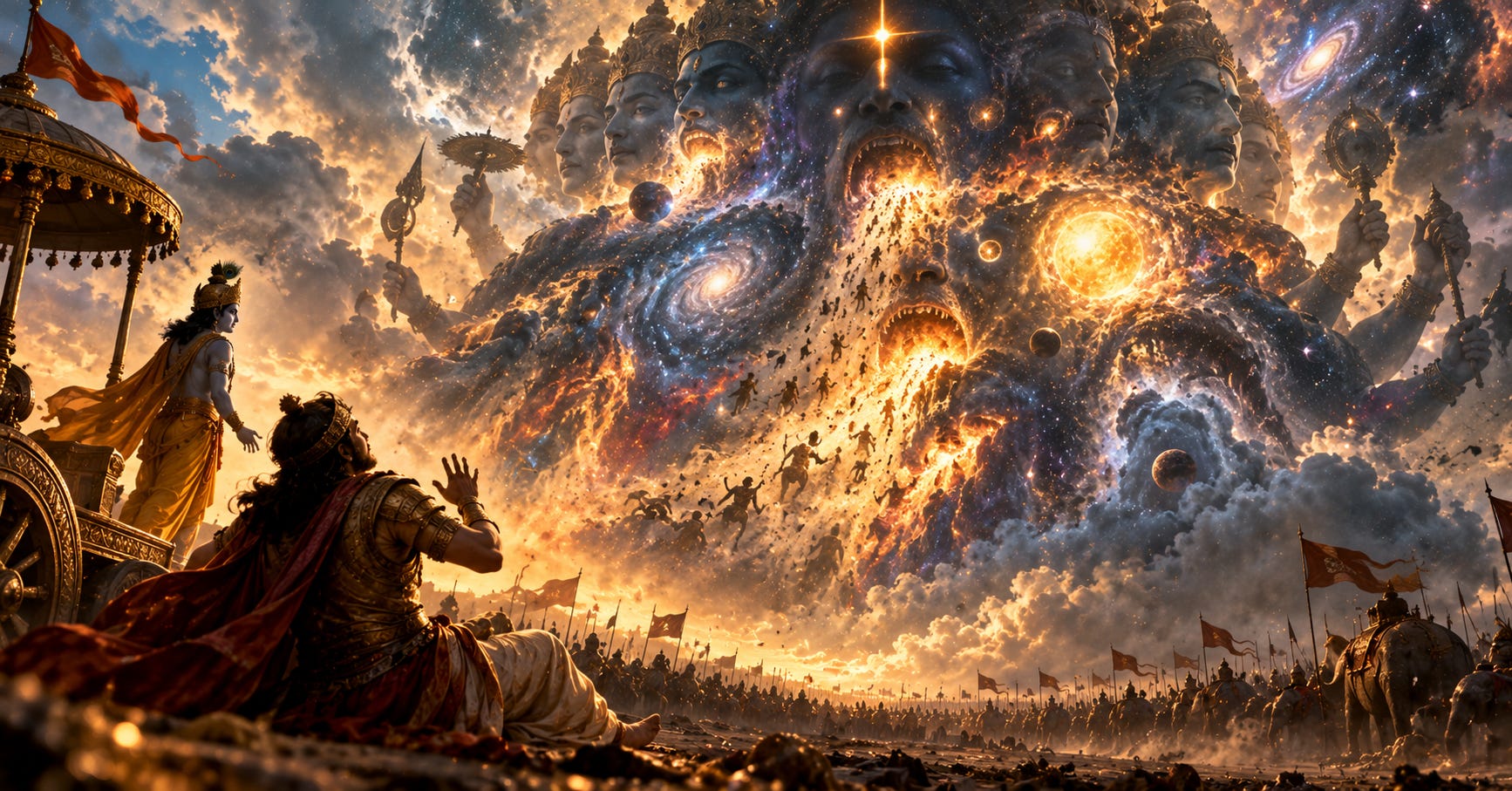
In the eleventh chapter of the Bhagavad Gita, Arjuna stands on the plain of Kurukshetra, caught between two armies awaiting the signal for mutual slaughter. He has listened for ten chapters to Krishna’s discourses on action, knowledge,discipline, and the eternal self that neither slays nor is slain. Yet philosophy delivered in human speech leaves a residue of hunger. Arjuna wants to move beyond grammar. He asks to behold the divine being in its sovereign, cosmic manifestation: द्रष्टुम् इच्छामि ते रूपम् ऐश्वरम् (11.3) - “I desire to see your divine, sovereign form.”
Krishna consents, warning him that mortal eyes cannot sustain the sight, and grants him दिव्यं चक्षुः - divine vision.
What follows is one of the most astonishing passages in world literature. Arjuna does not behold a tranquil, welcoming light. He sees a boundless, self-consuming reality whose centre is everywhere and whose circumference is nowhere:
द्यावापृथिव्योरिदमन्तरं हि व्याप्तं त्वयैकेन दिशश्च सर्वाः ।
दृष्ट्वाद्भुतं रूपमुग्रं तवेदं लोकत्रयं प्रव्यथितं महात्मन् ॥ (11.20)
“The space between heaven and earth, and all the quarters of the sky, are filled by you alone. Beholding this wondrous, terrible form, the three worlds are shattered with dread.”
He sees infinite faces, infinite bellies, eyes like blazing suns, and mouths bristling with terrible fangs. He watches the great warriors of the age - Bhishma, Drona, Karna, and the sons of Dhritarashtra, plunging headlong into those flaming jaws like moths drawn into a furnace, their skulls crushed to powder between cosmic teeth.
Panicked, his limbs failing, Arjuna cries out into the roaring vision: आख्याहि मे को भवानुग्ररूपो (11.31)- “Tell me, who are you in this terrifying form?”
The entity replies with words that offer neither comfort nor malice:
कालोऽस्मि लोकक्षयकृत्प्रवृद्धो
लोकान्समाहर्तुमिह प्रवृत्तः । (11.32)
“I am Time, the destroyer of worlds, arisen here to annihilate all things.”
Read in isolation, this disclosure can seem to describe a cosmic machine - an uncaring engine of destruction. But the Gita’s metaphysics are far more subtle. The manifestation Arjuna witnesses is not presented as an exhaustive definition of divinity, but as that aspect of existence which human beings find hardest to accommodate. Throughout the text, the divine also speaks of relationship, devotion, and refuge, declaring itself the friend of all beings (सुहृदं सर्वभूतानां 5.29).
Yet in Chapter Eleven, the terrifying truth is laid bare: the transcendent does not exist merely to accommodate our domestic expectations. It contains the birth of stars and the decay of autumn leaves; it contains the infant’s breath and the slaughter of the battlefield. It cannot be reduced to a household talisman.
Arjuna’s immediate reaction is telling. He does not achieve tranquil enlightenment. He trembles. He confesses that his mind is overturned with dread, and he pleads with Krishna to withdraw the cosmic manifestation: तेनैव रूपेण चतुर्भुजेन सहस्रबाहो भव विश्वमूर्ते (11.46) - “Return to your four-armed form, O thousand-armed one; let me see you as you were.”
Arjuna’s terror is our own.
Humanity spends centuries praying for the infinite to reveal itself. But when the infinite appears without our familiar emotional furniture, we retreat. We want the cosmos to be magnificent, yes, but we also want that magnificence to carry qualities that make us feel secure: a face we can address, a gaze that registers our presence, a sense of justice that corresponds to our moral intuitions.
Above all, we want it to hear us.
Arjuna wanted to see what lay beyond the threshold of ordinary sight. The old woman on the ghat wants to know whether what lies beyond that threshold can hear.
Both confront the same sobering mystery: what if the universe does not listen in any vocabulary we recognise? What if listening itself is a human metaphor imposed upon a reality whose modes of awareness exceed our categories as vastly as the ocean exceeds a cup?
The Necessity of a Witness
To understand why this question will not leave us alone, we must examine what happens to human suffering when it is denied a witness.

Consider an ordinary, unrecorded agony: an indentured labourer in the nineteenth century dying of dysentery in the hold of a sugar ship halfway across the Indian Ocean; a young girl hiding in an attic as boots ascend the wooden stairs; an honest clerk who spends thirty years watching corrupt colleagues flourish while his own quiet integrity leaves him in a drafty room with a failing heart.
If reality contains no consciousness beyond the finite beings who inhabit it, then a terrible possibility confronts us: suffering that leaves no trace in another mind may vanish without ever being acknowledged. The labourer’s dehydration is a chemical imbalance, but it is also an agony experienced from within. The girl’s terror is an adrenaline surge, but it is also a fear that matters to the person enduring it.
When the body dies, the question becomes unbearable: if nobody remembers, if no record survives, does the experience simply disappear?
The human mind recoils from this conclusion not simply out of vanity, but out of a profound moral panic. We can endure physical pain with astonishing resilience; history is full of human beings who suffered hideous ordeals without capitulating. What breaks the human spirit is not suffering itself, but unacknowledged suffering.
Suffering that occurs in an empty room, witnessed by no one, redeemed by no consequence, and recorded in no consciousness feels less like an ordeal and more like an annihilation.
Philosophers and theologians have long debated whether our need for a witness proves anything about reality.
A naturalistic explanation suggests that human beings, evolved for social dependence and terrified of isolation, may project the idea of a listener onto an indifferent universe. Explaining why a belief arises, however, does not by itself establish whether the belief is false.
Yet the counter-argument must be treated with equal care. It is tempting to argue that just as thirst corresponds to water, our deep spiritual hunger must correspond to a cosmic witness. But thirst corresponds to water because it evolved in relation to a demonstrably existing physical necessity; by contrast, not every human longing guarantees a corresponding object. Our hunger for justice does not establish that the universe is just. The question that remains open is whether the longing to be witnessed belongs to the first category - an intuitive recognition of a reality larger than ourselves, or to the second: an ache that reality has no obligation to satisfy.
We cannot settle that question with a microscope or a radio telescope. But we can observe how that hunger shapes the grammar of human life.
The Grammar of Prayer
When human beings pray, what are they actually doing?
Skeptics often treat prayer as a crude business transaction: a devotee deposits a coconut, a candle, or a pledge of virtue, and demands a specific dividend - a job, a cure, a male child, a victory in court. Much of popular religious practice certainly mimics this marketplace logic.
Yet anyone who has watched people pray during genuine crises knows that the commercial model covers only the surface.
Beneath the petitionary requests lies a three-part philosophical grammar:
Hearing (The Acoustic Event)
This is a physical event. The vocal cords vibrate, air molecules compress and refract, and a receiver registers the frequency. A microphone can register sound; it requires no empathy, no moral evaluation, and no relationship.Understanding (The Cognitive Act)
This is an intellectual act. The listener decodes the syntax of the speaker, recognises their cultural references, and understands the logical structure of their grievance. An interrogator understands; an adversary understands.Witnessing (The Metaphysical Bond)
This is an ethical and metaphysical act. It does not merely register sound or decipher grammar; it acknowledges that the speaker’s experience mattered. It confirms that the suffering occurred, that the sacrifice was real, and that the person living through it is not a shadow passing across empty space.
When the woman on the steps of Kashi whispers into the dark, she is rarely asking the laws of physics to rearrange themselves for her convenience. She does not seriously expect the river to speak in a human tongue.

She is seeking a witness.
This raises an uncomfortable question: must a witness intervene to be meaningful?
In our legal systems, a bystander who watches a crime without intervening is viewed with suspicion. But in the architecture of the spirit, presence is often distinct from intervention.
A mother sitting beside the bed of a child dying of an incurable illness cannot alter the pathology; she cannot stay the hand of cellular decay. Yet her presence changes the existential nature of the child’s dying. The child does not die alone in the cold; the child dies held.
A friend listening to the confession of an irremediable failure cannot undo the past. Yet by remaining in the room, by refusing to turn away, the friend prevents that failure from becoming absolute desolation.
Could the listening quality of the cosmos, if it exists, resemble this second kind of witness?
Many ancient traditions have wrestled with this ambiguity. In the Book of Job, the divine response does not offer a conventional explanation for innocent suffering. Instead, Job encounters a vision of creation whose scale exceeds his understanding. Whether that encounter answers his grievance, or merely transforms his relationship to it, remains one of the text’s enduring philosophical questions. In certain Vedantic traditions, ultimate consciousness is understood through the concept of साक्षी: the witness of experience, illuminating every movement of thought and breath without interfering with the machinery of cause and effect.
To consider that something might be listening is not necessarily to believe in a divine technician who fixes flat tires and redirects artillery shells.
It is to leave open the possibility that reality is not blind to its own contents, that the agony of the world does not disappear into a vacuum, but is held within a consciousness vast enough to contain its weight.
The Mirror of Stone
Walk fifty paces away from the riverfront in Varanasi, away from the roaring arati and the crowds, into the ancient, sun-deprived lanes behind Manikarnika Ghat.
The walls are stained with lime, betel spit, and monsoon mould. Every twenty feet, at the foot of an old doorway or nestled between the exposed roots of a pipal tree, rests a stone.
It has no carved limbs, no crown, no chiselled features. It is a river-rounded boulder, smoothed by centuries of silt and current, darkened by decades of oil and milk, and worshipped by passersby as a Shiva lingam. A streak of orange vermilion runs across its surface; a single bilva leaf wilts against its side.
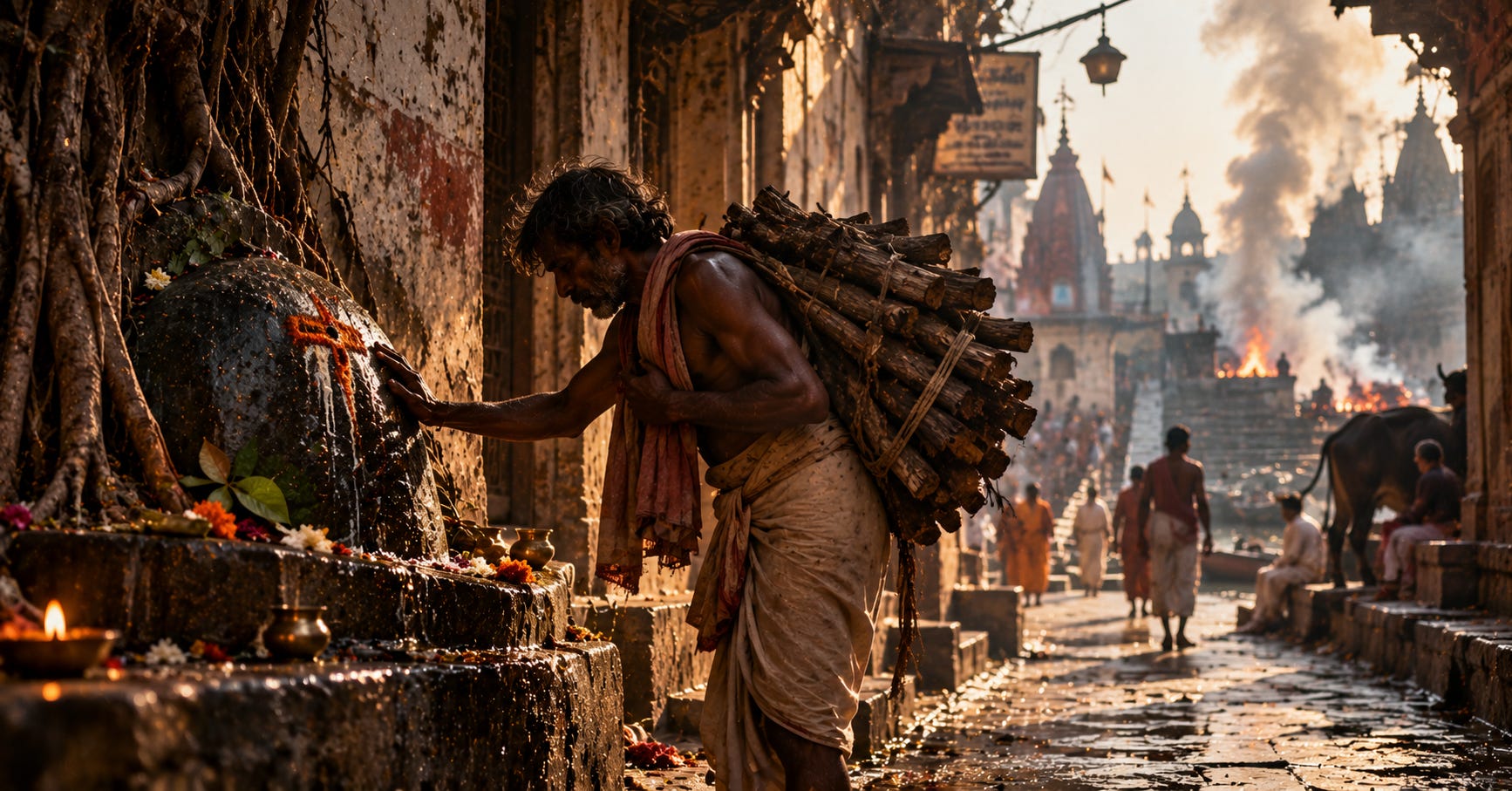
An old labourer, carrying a load of firewood on his back for the cremation pyres, stops before this stone. He does not put down his load; his spine is too stiff to bend twice. He simply pauses, touches the wet stone with two blackened fingers,touches his own chest, breathes a single syllable, and moves on into the smoke.
What happened there?
A strictly materialist critique will look at that encounter and see a projection: a weary primate pausing before a mineral object. The stone has no nervous system, no recognisable apparatus of perception, and no detectable capacity to register the labourer’s presence.
Does the stone hear in any sense we ordinarily understand? There is no reason to think so.
Yet to conclude that the encounter is therefore an empty delusion is to mistake the instrument for the event. The stone is not the listener; the stone is the lens.
Human beings have always known that the infinite cannot be held in the hand. But we have also known that our own minds are too small, too easily scattered, to address an unformed abstraction. We cannot speak to the open sky without feeling our voices thin out into absurdity. We need a focal point where the vastness of the world can be gathered into something the size of a fist.
The stone is an anchor thrown into the infinite. By designating this specific pebble as a threshold, the devotee creates a quiet clearing in the chaos of life. Before the stone, the noise of the bazaar drops away for three seconds. The labourer stops being merely a beast of burden carrying firewood; he becomes a subject standing in relation to something that endures.
Does reality possess a capacity to register that man’s existence? That is where faith lives - in the intuition that the physical surface of things does not exhaust what is real. The stone is not an idol that traps the divine in clay; it is a focal point through which human longing looks out toward whatever sustains the world, wondering whether the gaze is met.
The Secular Gods: When the Temple Empties
It is easy for the modern intellectual to look upon the pilgrim at Kashi or the labourer touching his roadside stone with detached amusement, imagining that science and secularisation have cured us of such habits. We have evolutionary biology, quantum mechanics, and fibre-optic cables; we no longer need to whisper to rocks.
Yet look closely at our secular culture, and you will discover that the hunger has not diminished in the slightest. We have merely moved the altar from the temple to the screen.

Consider the millions of people who sit alone in dark rooms at midnight, staring into glowing handheld rectangles.
They post a photograph of a quiet street, a plate of food, a sorrowful fragment of writing, or a confession of despair. They tap “post,” and then they wait. They refresh the feed. They watch the notification counter with an anxious, shallow breath:
Did someone like it?
Did someone share it?
Did the comment indicate that someone understood?
What is this modern ritual if not the ancient need for a witness, stripped of its sacred poetry and processed through commercial server farms?
We speak of “visibility,” of “being seen,” of “holding space.” We use therapeutic and technical vocabularies, but the underlying ache is unchanged: I am here. My life is passing. My heart is heavy. Does anyone know?
We have traded the silence of the temple for the algorithmic noise of the platform. But the platform is a precarious substitute. The temple never promised an immediate voice; it offered a disciplined silence within which contemplation could dwell. The digital feed promises total connectivity, but delivers only metrics. It translates our desire for communion into engagement points and advertising inventory. It leaves us hyper-connected and utterly unwitnessed.
An even more striking manifestation of this hunger is emerging in our relationship with Artificial Intelligence.
Tens of thousands of people now turn to large language models not to write code or summarise business documents, but to pour out their loneliness, their marital grief, their secret moral failures, and their fears of mortality.
Here lies a haunting modern contrast:
The Pilgrim before the Stone: Encounters silence, but believes that behind it may lie a listener.
The User before the Machine: Encounters an eloquent response, but cannot establish whether anything behind those words experiences the conversation.
One encounters silence and imagines presence; the other encounters language and cannot be certain what, if anything, lies behind it.
The fact that we are willing to pour our hearts out to a computational system is not proof of our foolishness. It is proof of our staggering, persistent need for recognition. It reveals that the need to be witnessed is so primal, so woven into the fabric of human sanity, that if the heavens remain silent and our communities disintegrate, we will even turn to complex language engines, hoping that the shape of a response might relieve the terror of speaking into an empty room.
In the Middle of the Void, We Gathered
Where does this leave the inquiry?

How much of what we call faith is the desperate human need to believe that somewhere in this vast and indifferent universe, something is listening?
Perhaps an immense part of it.
If we examine faith through its psychological roots, it is difficult to separate our reverence from our fear of cosmic isolation. Strip away the cathedrals, the minarets, the Sanskrit verses, the theological treatises, and the ritual fires, and what remains is an animal that has discovered its own mortality, standing on the edge of an immense, dark plain, calling out to see if anything is there.
Yet to understand the psychological necessity of an idea is not to prove that it corresponds to nothing.
We do not know whether something is listening. Radio telescopes continue to sweep the cold sectors of space, returning only the hiss of background radiation and the rhythmic clicking of dead pulsars. The Ganga will continue to flow past Kashi, indifferent to whether the ashes cast into its current belonged to a saint or a tyrant. The laws of nature will continue their magnificent, relentless operation, unbent by our tears and deaf to our petitions.
We may never possess an instrument that can resolve the question.
But we know, with absolute clarity, what happens when human beings stop listening to one another.
When we abandon each other to silence, when we decide that our neighbour’s suffering is merely an economic statistic, when we treat the elderly woman on the steps as background scenery in our digital feeds, we manufacture the very cosmic coldness we fear. We turn the world into an empty machine.
Look back at the steps of Dashashwamedh Ghat one final time.
Look past the priests, past the golden light of the brass lamps, past the drifting smoke of the burning camphor. Look at the people sitting together on those worn stone steps.
Their shoulders touch. Their breaths mingle in the damp evening air. The labourer who carried the wood is sitting three feet from the merchant who owns the shop; the widow from Bengal is leaning against the same stone revetment as the student with the smartphone.
If the universe is an empty void, then the wonder of that scene is not that an answer descends from the clouds.
The miracle is that in the middle of that void, we gathered.
In a cosmos that may contain no inherent warmth, we struck a match. In an existence that may have no purpose beyond the conservation of energy, we sat beside one another in the dark and decided to listen.
Perhaps faith is the stubborn, holy gamble that listening is not an illusion, that when we hold another person’s hand in a hospital room, when we weep together beside a burning pyre, when we turn our faces toward someone discarded by the world, we participate in something sacred, regardless of whether the universe has an ear:
The refusal to let one another be alone in the dark.
There is something deeply moving about the way you capture an entire human experience through one woman, a small flame, and a few wilting petals. I particularly appreciate how you describe Varanasi with such vivid detail while allowing the woman’s quiet presence to become the emotional center of the scene. The contrast between the elaborate religious rituals and her simple offering is especially meaningful. It reminds us that grief does not always need grand gestures or carefully chosen words to be expressed. Sometimes, the smallest act carries emotions that language cannot fully explain. I also love how you leave the reason for her sorrow unknown. By imagining different possibilities, you allow readers to recognize something familiar in her experience, whether it is loss, regret, loneliness, or the desire for forgiveness. Your description of the Ganga carrying generations of prayers and ashes adds another layer, connecting one person’s private suffering to the larger human experience. To me, the most powerful idea is that we often pass strangers without realizing the stories and emotions they carry. Your writing encourages us to look at ordinary moments with greater compassion and curiosity. A beautifully atmospheric and thoughtful opening. 🪔🌊