

The Bait
Let us step back for a moment. Take a breath and remember. It is 2016. Do you remember the queues? Not the ones outside the banks… those came later that winter, born of panic and midnight decrees. No, I am talking about the rain-slicked queues outside those derelict storefronts, stretching around the corners of dusty Indian bazaars. People standing for hours, all that unease, the gloom, waiting for a little piece of plastic. A SIM card.
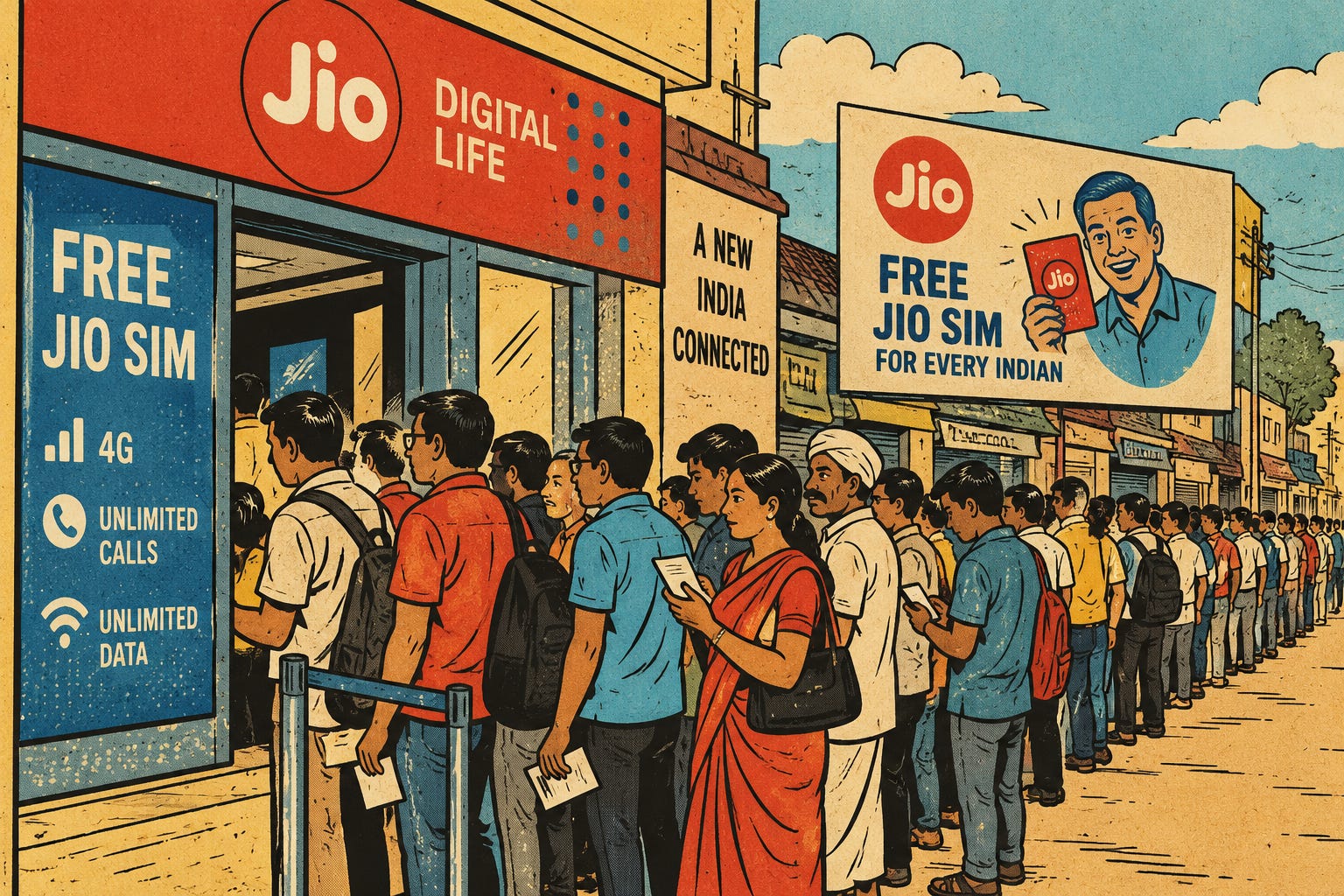
They promised it was free. 4G. Unlimited data, unlimited calls, for months on end. It felt like an act of corporate benevolence, didn’t it? A grand, sweeping democratization of the airwaves. You brought your Aadhaar card, you scanned your thumb, and just like that, the floodgates opened. For a teenager in a tier-3 town, or a rickshaw puller resting under a tree, the universe suddenly expanded. We all remember that exact intoxication. The sheer thrill of streaming a video without watching the buffer wheel spin. The late nights spent falling down digital rabbit holes, the casual sharing of clips, the sudden, effortless connection to everything and everyone. It was glorious. It was deeply nostalgic. It was the golden summer of our digital innocence.
Consider what lay beneath that innocence. Before this moment, the internet was a deliberate destination. You walked into a cyber café, smelled the faint scent of sweat and dusty keyboards, and paid ten or twenty rupees an hour. You watched the clock. You were deeply conscious of every kilobyte. The web was a tool, a rare privilege, an elite luxury. Then, almost overnight, the constraint vanished. When something becomes infinite, our relationship with it fundamentally alters. We stopped consuming information; we began to drown in it. The late-night scrolling wasn’t just entertainment; it was the slow, methodical rewiring of human attention spans.
Millions of people who had never owned a computer suddenly held a device capable of broadcasting to the entire world, right in the palm of their hands. The psychological defenses we usually build over generations against new mediums were completely bypassed. We didn’t learn to swim; we were simply thrown into the deepest part of the digital ocean and told that the water was free.
Now, stop right there.
Look up from that memory. Why do you think I am bringing this up? Why start a grand discourse on ethics, morality, and the very soul of a nation with a corporate balance sheet and a marketing campaign from a decade ago?
Because that little plastic card was not just a consumer product. It was the master catalyst of a profound transformation. This was the moment latent digital possibilities became an immediate, inescapable behavioral reality. That was the day the true digital age in India actually began. We thought we were receiving a magnificent gift. In reality, we were signing the lease on our own consciousness.
The Miracles and the Trap
Every nation has its grand transition, its historical inflection point. For decades, India’s digital journey was a slow, bureaucratic crawl. We boasted loudly about our gleaming IT hubs in Bengaluru and Hyderabad, but let’s be honest: that was an elite story, a narrative of high-walled tech parks and coding languages spoken by a tiny fraction of the population. The rest of the country watched from the periphery, counting data charges by the megabyte, treating the internet as a strictly metered utility, like water in a brutal drought.
Then came the alignment of forces. It would be a failure of analysis to look at a single corporate entity as a solitary meteor. No, the corporate rollout was the match dropped into a powder keg that had been meticulously packed for years. ‘The state’ had already built the foundational architecture of identity through Aadhaar and transactions through the Unified Payments Interface (UPI). Market forces had simultaneously flooded the bazaars with remarkably cheap, mass-manufactured hardware from across the border. The infrastructure of scale was ready. When the free data arrived, it acted as the universal solvent, binding state infrastructure, cheap silicon, and over a billion individuals into a single, interconnected neural network.
But when you flood a traditional, deeply religious, and intensely communal society with a sudden, unregulated deluge of hyper-connectivity, the social fabric doesn’t just stretch…it snaps.
Let us look closely at the miracles this solvent produced before we dissect the rot, for a true master of the board always understands the value of the bait. Watch the small-scale vegetable vendor in a tier-2 town casually accept a digital payment via a laminated QR code pinned to his wooden cart. He is suddenly liberated from the ancient, grinding tyranny of loose cash shortages and the extortionate rates of local moneylenders. Watch the daughter of a daily-wage laborer in a remote district sit under a thatched roof, learning advanced data analytics from a free video lecture on a five-inch screen. Consider the small-town creators, the rural folk artists, and the localized storytellers who suddenly found a direct, unmediated line to a global audience, completely bypassing the traditional, high-caste gatekeepers of cultural capital. This was a magnificent triumph of financial and cognitive inclusion. It gave voices to the voiceless and agency to the marginalized.
Yet, a seasoned strategist admires the beauty of a trap precisely because of how magnificent the bait is. Look at how flawless the cage is; who wouldn’t want to step inside? The very tools that democratized access also stripped away the traditional shock absorbers of our civilization.
In Western nations, the consumer internet evolved gradually over three decades. Users transitioned systematically from dial-up text forums to basic personal blogs, from desktop web portals to early social networks, and finally to high-speed mobile feeds. There was time for legal frameworks to expand, time for labor practices to adjust, and time for cultural norms to settle. India, by contrast, skipped the desktop era entirely. A massive portion of our population leaped straight from information scarcity to high-speed algorithmic hyper-saturation.
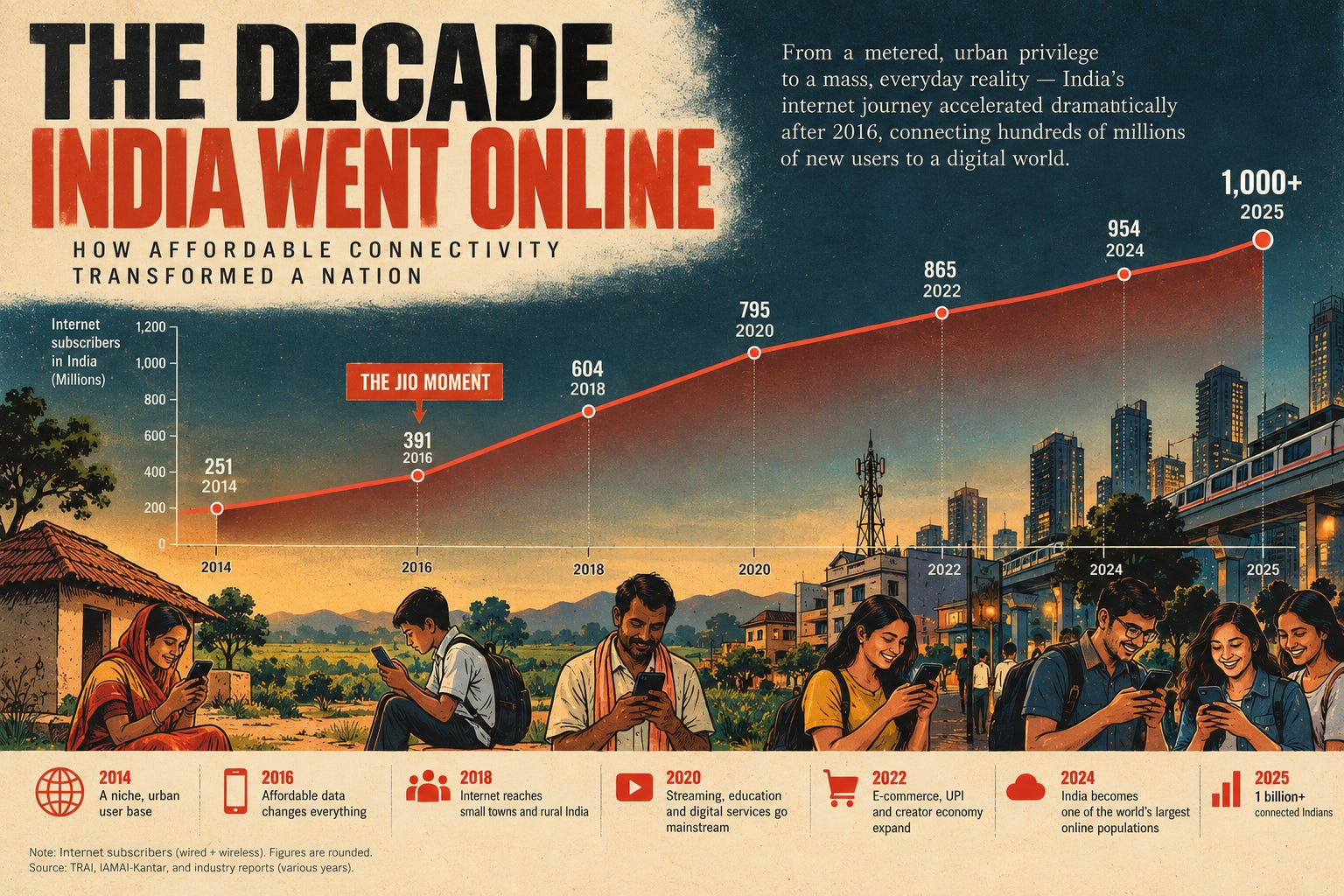
The media theorist Marshall McLuhan famously noted that “the medium is the message”: that the structural characteristics of a new technology matter far more than the content it carries because they fundamentally alter the scale, pace, and form of human association. When a society jumps directly into the deep end of behavioral algorithms without intermediate steps, the traditional structures of authority are instantly bypassed. The local elder, the village panchayat, the multi-generational family unit… the historical shock absorbers of Indian life, were rendered obsolete in a matter of months. The youth suddenly possessed a secret, parallel universe that their parents could neither understand, interpret, nor monitor. The moral compass of the past was quietly demagnetized by the sheer, unyielding pull of the digital screen.
The Automated Arena
Which brings us to the core of our problem: morality. We throw that word around as if it were a fixed star in the night sky, permanent and unyielding. But what exactly is a moral crisis? Morality is the unwritten contract that keeps us from tearing each other apart when the police aren’t looking. It is the quiet, organic understanding of right and wrong, shaped by centuries of community, family, and faith. A crisis of morality occurs when the old rules no longer apply, but no new rules have been written to replace them. It happens when the tools we use outpace the philosophy we possess to govern them. Sociologist William Ogburn called this “cultural lag”: the painful period where non-material culture struggles to adapt to rapid technological adjustments. We are running twenty-first-century software on an industrial-era moral operating system, and the system is crashing.
Let us leave the abstract theory behind. Walk with me through the headlines of the last few weeks. Not the sanitized versions on the nightly news, but the raw, unfiltered reality of our streets and screens.
Consider the lynchings that erupted across rural and semi-urban India, sparked by nothing more than a forwarded video on a messaging app. Strangers arriving in a village, completely misidentified as child lifters by a viral rumor, chased down and beaten to death by a crowd of ordinary citizens. Think about those men who held the sticks and threw the stones. An hour prior, they were peaceful farmers, shopkeepers, and loving fathers. What happened to their morality?
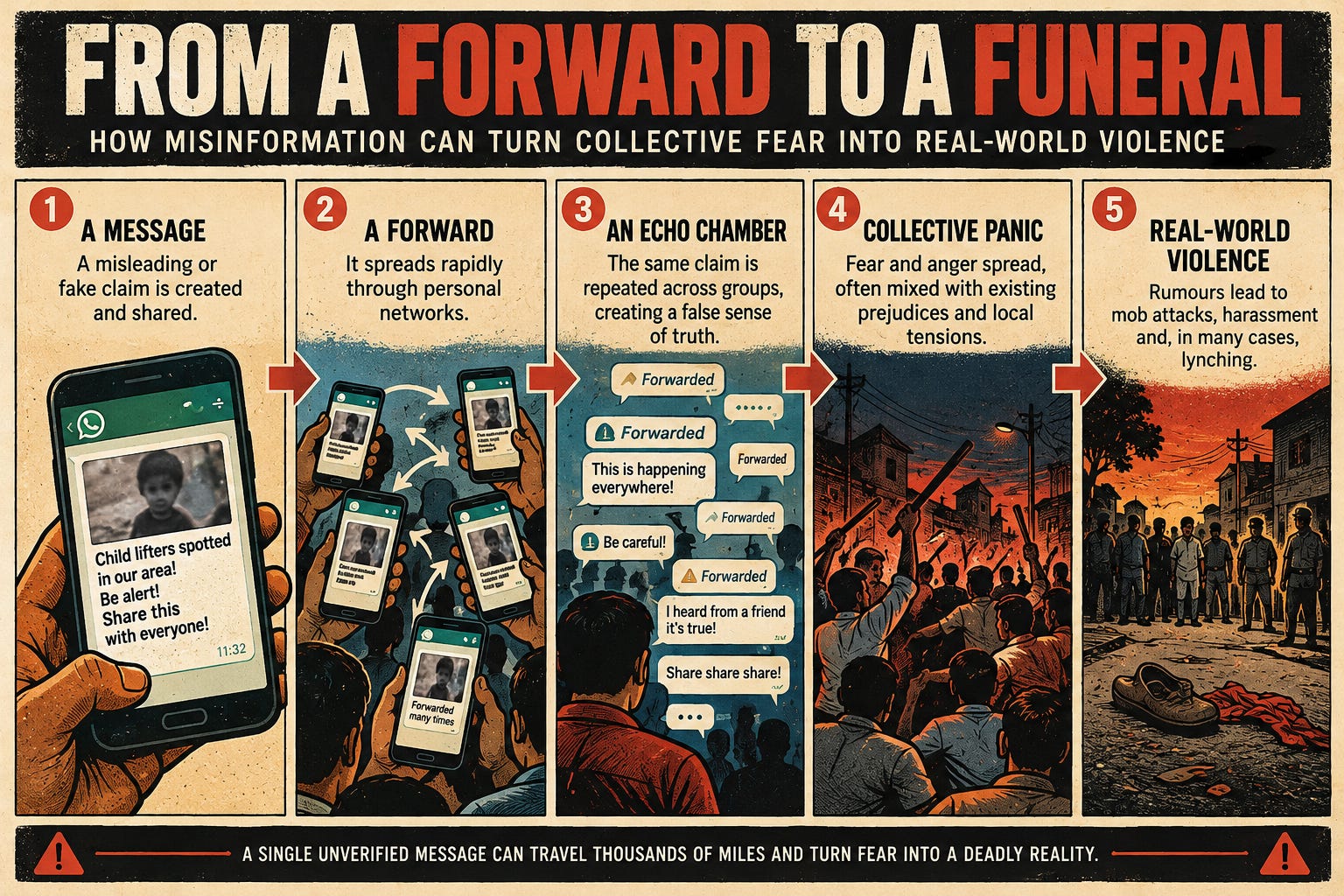
The digital space completely removed the face-to-face feedback that normally restrains human cruelty. When you insult or threaten someone in a crowded physical marketplace, you see the pain or terror in their eyes. You hear the sharp intake of breath from the bystanders. Your own biological systems register the immediate physical tension, and your evolutionary wiring flags it as a dangerous, high-stakes conflict. But when you type a vicious comment or forward a terrifying rumor on a screen, there is no biological feedback loop. You hit “send” and are immediately rewarded with likes, replies, and social validation. The suffering of the person on the receiving end is completely invisible. We have built an architecture that amplifies our worst impulses while completely insulating us from the emotional consequences of those impulses. This is the true crisis: the automation of malice and the sterilization of empathy.
Or look at our youth. Think of the young college students in our major metros trapped in the dark web of deepfake extortion. A regular, innocent photograph lifted from a public social media profile, manipulated by a free, easily accessible artificial intelligence tool into something explicit, and weaponized to destroy a life. We have seen bright, ambitious young minds driven to tragic suicides because their digital reputation was compromised by anonymous actors hiding behind disposable accounts and anonymous screens. The moral cost of a human life has been reduced to the ease of a software click.
Look closely at the crowded “IT cells,” where young men are recruited, poorly paid, politically incentivised, or ideologically mobilised to sit before monitors, manufacturing synthetic outrage, doctoring videos, and systematically dehumanizing anyone who questions the party line. They don’t see it as lying; they see it as “engagement.” They do not perceive the moral weight of destroying a reputation because the victim is merely an avatar, a profile picture, a collection of distant pixels.
Social psychologist Jonathan Haidt has argued extensively that digital platforms accelerate tribalism and corrode the shared trust on which democratic life depends. The algorithms of our social media platforms are engineered to reward this exact behavior. Outrage sells. Fear sticks. Polarizing a neighborhood gets infinitely more clicks than uniting it.
The Symbiotic Cage
To understand the political implications of this automated arena, we must look directly at the generation that inherited this digital wilderness: the Indian Youth. They are a demographic marvel - hundreds of millions of individuals under the age of thirty, full of burning, hyper-visible aspiration, yet balancing precariously on a tightrope of severe economic and structural uncertainty.
The digital age promised them absolute liberation. It gave them instant access to global trends, online education, and a global voice. But it also handed them the volatile “Online Disinhibition Effect”, a psychological phenomenon where the anonymity and physical distance of the internet lower traditional behavioral barriers. For many young Indians, especially in socially conservative settings, physical life remains tightly bound by intense, centuries-old social hierarchies: strict deference to elders, rigid caste dynamics, religious expectations, and the heavy burden of family honor. But online? Online, those ancient barriers dissolve completely. Behind an anonymous handle or a generic profile picture, the deeply repressed frustrations of an entire generation find a volatile, explosive outlet.
This has given rise to a structural landscape of performative morality. Go on any social media platform today and watch the young elites and the working-class youth alike participate in these digital rituals. Online platforms often reward the appearance of moral participation more efficiently than the slow, invisible labour of civic action. They post trending hashtags, change their profile pictures in solidarity, and hurl vitriol at ideological opponents simply to prove their own moral purity to their peer group. At its worst, it becomes an illusion of action: a carefully curated performance that enhances social status while demanding little material commitment in the real world.
Beneath this loud, performative righteousness lies a profound irony: the loneliness epidemic. The Indian youth are hyper-connected but deeply, structurally alienated. They have thousands of digital followers but absolutely no one to talk to when the screen goes dark. The organic networks of the village square, the joint family, and the local neighborhood have been rapidly replaced by the transactional architecture of the feed. And a lonely mind is a profoundly fragile mind, exceptionally vulnerable to radicalization, manipulation, and despair.
Consider the structural trap this generation finds itself in. They look at their screens and see a world of hyper-luxury, global travel, and instant success, curated by influencers who seem no different from themselves. Yet, when they look away from the screen, they face the harsh realities of hyper-competitive exams, stagnant job markets, and immense familial pressure. The gap between digital aspiration and physical reality is vast and deeply painful. The smartphone becomes both the source of their agony and their only escape from it. They retreat further into the digital world, seeking validation through likes and views because the real world offers them so little agency. In doing so, they become easy prey for demagogues and corporations who know exactly how to turn that deep frustration into profitable outrage.
This brings us to the grand masters of this board: Indian Politics. Politics has always been about the careful management of illusions. But the digital age has given politicians the ultimate, unparalleled tool for engineering reality itself. In the old days, a politician had to travel out to a remote village, stand on a creaking wooden stage, and look the electorate directly in the eye. There was a physical accountability, a tangible human presence to the performance.
Today, a political narrative is precision-targeted with surgical accuracy. We have entered the era of what Shoshana Zuboff terms “Surveillance Capitalism”. An economic order where human experience is claimed as free raw material for translation into behavioral data. Every bias, fear, insecurity, and preference of the Indian voter is harvested, packaged, and analyzed. If you are a young man deeply worried about unemployment, the algorithm knows it before you even speak it aloud. And it will serve you a highly specific video explaining exactly which minority group or political enemy is responsible for stealing your future.
We have entered a true post-truth era in Indian governance. Objective facts have not disappeared, but they no longer circulate within a universally trusted system of verification. If a government department releases economic data that is unfavorable, a brilliant counter-narrative is instantly manufactured and deployed by digital armies. Deepfakes of political leaders saying things they never said, or endorsing radical positions they fiercely oppose, circulate unchecked through millions of smartphones every hour. Trust. The foundational, unwritten moral contract of our republic is being systematically dismantled day by day. When every fact can be dismissed as partisan fabrication, power belongs not to the one with the best arguments or the most noble policies, but to the one who controls the infrastructure of distribution.
Look at how political campaigning has fundamentally changed. It is no longer about publishing a manifesto or debating policy on public forums. It is about narrative dominance. The modern political party functions like a media network, producing thousands of pieces of content daily, tailored to the specific anxieties of different sub-castes, regions, and age groups. They don’t need to convince you; they just need to flood the information ecosystem so completely that you lose the capacity to distinguish between truth and falsehood. The moral restraint that once prevented leaders from exploiting raw communal hatred has been abandoned. Why? Because political strategists have repeatedly learned that communal polarisation can consolidate votes and displace more difficult questions of governance.
And yet, the same networks have exposed abuse, organised relief, documented injustice, and allowed citizens to challenge institutions that once controlled the public record. But this emancipatory potential exists inside infrastructures whose incentives still privilege speed, spectacle, and emotional intensity over verification.
Are there solutions?
The well-meaning academics will tell you about “Ethics by Design”. The noble idea that tech companies should build human rights and moral safeguards directly into their source code. They will talk endlessly about robust digital literacy programs in schools to teach children critical thinking over emotional reaction. They will passionately advocate for strict data protection laws to prevent our private lives from being sold to the highest bidder in the market.
But let us be completely honest and pragmatic with ourselves. Who honestly has the incentive to implement these fixes?
Do the tech platforms truly want to stop the outrage? Outrage is exactly what keeps your eyes glued to the screen, and those collective eyeballs are worth billions of dollars on the global stock exchange. Do the political parties genuinely want an informed, calm, and critically thinking electorate? A calm electorate asks exceedingly difficult questions about public services, healthcare, infrastructure, and economic policy; an outraged electorate simply votes out of raw, primal fear.
We are left in a deeply ambiguous, unsettling state. The digital age has given us unprecedented, god-like power, but it has completely hollowed out the very moral structures that taught us how to use power wisely. We sit alone in the dark, illuminated only by the cold glow of our smartphones, scrolling restlessly through an endless feed of manufactured anger, performative righteousness, and beautiful, convenient lies.
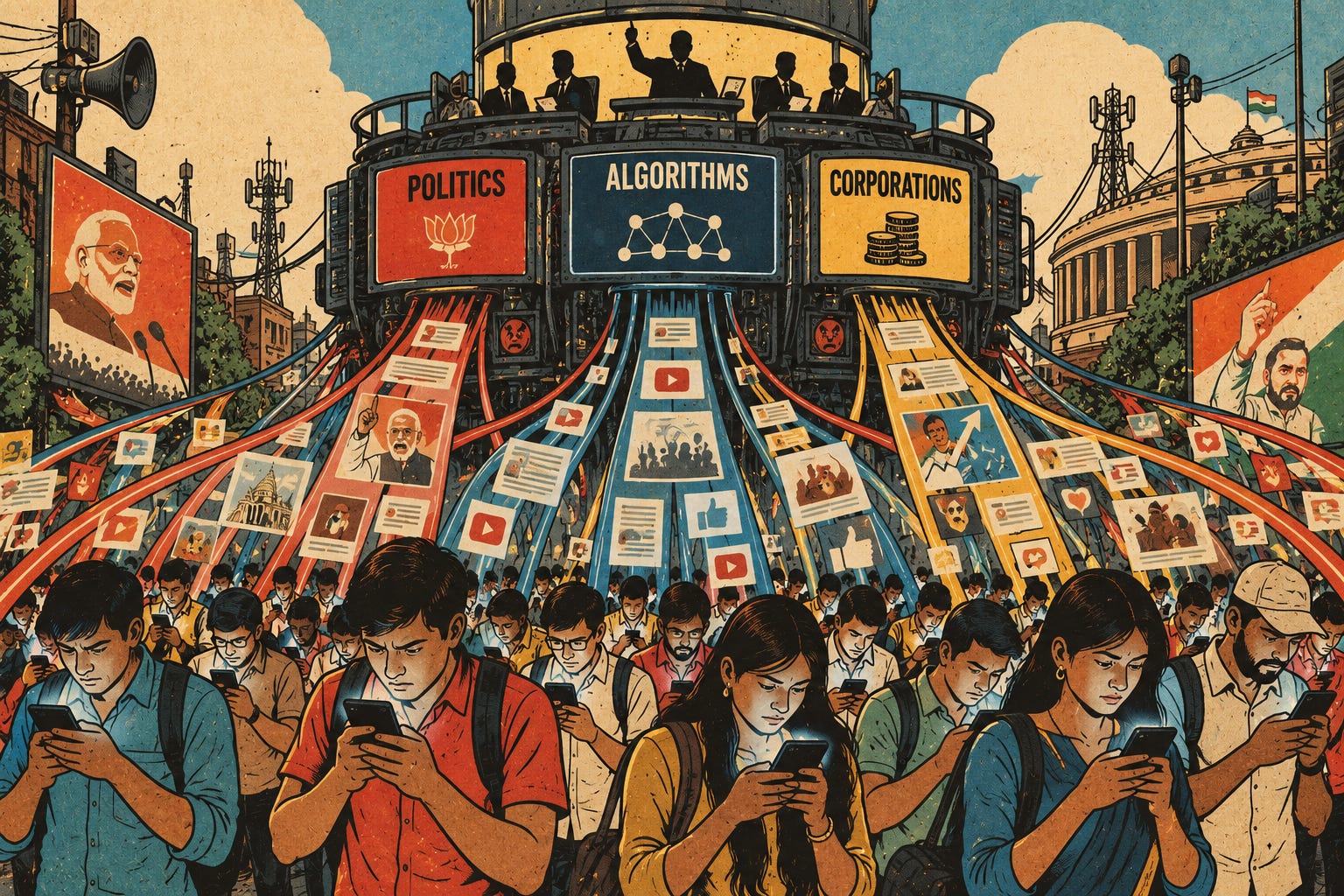
The free lunch we all so eagerly lined up for in 2016 was never actually free. We paid for it with our privacy, our institutional trust, and our collective sanity. But do not look for a solitary villain in the boardrooms or the halls of Parliament. Look instead at the symbiotic trap we have co-created. We are witnessing a form of digital Stockholm syndrome. The system holds us captive, fracturing our society and draining our attention, yet we fiercely defend it because it offers convenience, connection, visibility, and validation. Platform economics require our attention, the political class requires our fear, and our own psychology craves recognition. The gates to our prison are wide open, the screens are glowing, and we have fallen head over heels in love with our captors.
The question is no longer whether we can break out of the cage. It is why we would ever choose to leave it.