

The Spotlight and the Lantern
We are taught to measure human existence by the intensity of its personal luminescence.
From childhood, the cultural ideal whispered into our ears is one of solitary brilliance: the blazing prodigy, the towering historical figure, the monumental career, the life that burns so brightly it scorches its name into the public record. We celebrate those who command rooms, those who gather crowds, and those whose achievements outshine the ordinary landscape around them. In this framework, life is conceived as an endurance race of self-display. The unspoken ambition is to become a star. An isolated, self-generating furnace of light whose primary virtue is its capacity to be seen from a distance.
Yet the star is an incomplete metaphor for human living.

In nature, a star is not an act of vanity; it provides the gravitational anchor and physical warmth that makes biology possible. In human culture, however, the ideal of the solitary star is routinely conflated with something far narrower: the spotlight. A spotlight singles out a figure for attention. A lantern illuminates the space through which others must pass.One asks us to look towards its subject; the other helps us see what lies ahead.
To define life entirely by the height of one’s platform or the reach of one’s visibility is to confuse the performer with the illumination. Personal ambition is not inherently hollow, nor is historical achievement evidence of vanity; a scientific discovery, an enduring book, or an engineered vaccine can cast light across generations. The error lies in mistaking the spotlight for the purpose of light itself. What if the worth of our brilliance lies not in how brightly it makes us visible, but in what it allows others to see?
What if the primary beauty of being alive has less to do with the duration of our personal display, and far more to do with what that light makes bearable for someone else?
An Ordinary Room at 3 AM
To understand the difference between the spotlight and the lantern, one must leave the auditorium and step into an ordinary room at three o’clock in the morning.
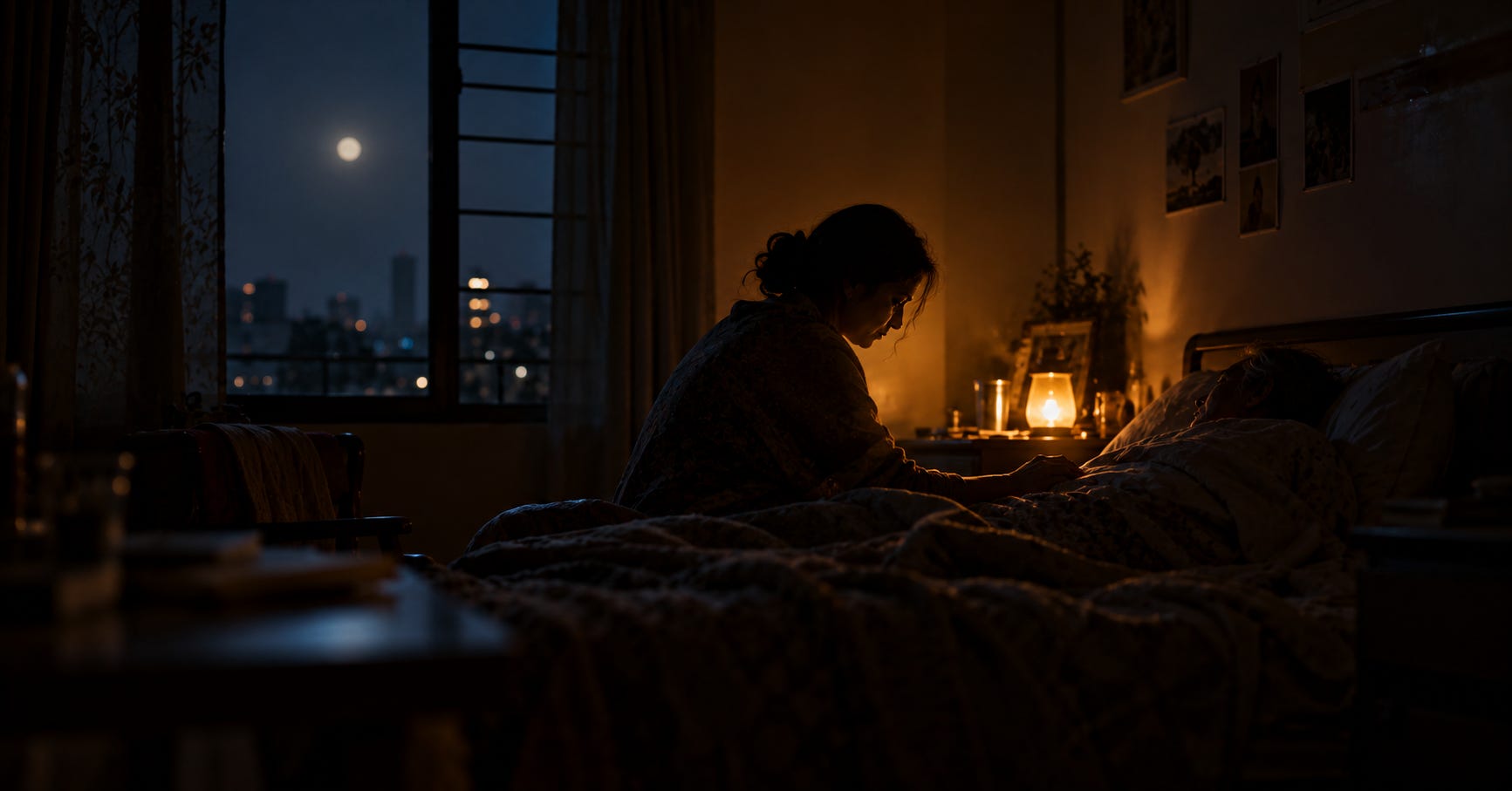
Darkness in human life is rarely an abstract poetic trope. It possesses physical weight, texture, and silence.
It is the hollow, ringing quiet that fills a house in the weeks following a bereavement, when the condolences have ceased,the relatives have boarded their return trains, and the survivor sits alone with the impossible silence of an unmade bed. It is the sterile, humming corridor of an oncology ward where a family waits for the results of a biopsy, watching the fluorescent tubes flicker against pale linoleum. It is the sudden, cold reckoning of an economic catastrophe, or the internal collapse of someone who looks at their own life and finds no reason to pull back the blankets at dawn.
When a human being is trapped inside that kind of dark, abstract achievements and distant brilliance reveal their limits.
This is not because philosophy, science, or art are useless. Medical research discovers the therapies that save lives; structural economic reforms alleviate systemic miseries; literature gives voice to isolations that previously had no name. But in the immediate, suffocating centre of a crisis, an abstract achievement cannot substitute for human presence. A brilliant treatise on the evolutionary necessity of grief does not dry a single tear. The applause filling a distant auditorium cannot reach the person shivering on the floor.
Worse still is the modern reflex to offer forced optimism - the insistence that darkness is merely an attitude problem, that grief can be reframed into personal growth, that pain is simply an experience waiting to be optimised. This counterfeit luminescence does not heal; it wounds. It demands that the suffering person perform gratitude while their chest is still crushed under an unbearable stone.
Suffering, to be sure, is not a uniform or static monolith. Much of what human beings endure - preventable disease, crushing poverty; the structural indignities of neglected public systems, is not an inevitable law of the universe. It is the consequence of human failure, and we have a moral responsibility to dismantle the structures that produce it.
Yet even in an entirely just society, finitude remains. Bodies age, accidents happen, hearts break, and mortality arrives.You cannot organise or argue away the fundamental vulnerability of conscious life.
The question is never whether the night will arrive. The question is what we do when someone must walk through it.
The Canopy of Filaments
In an ordinary festive street at night, there is a visual image that untangles the vanity of the solitary spotlight.
Suspended across the alley is a temporary ceiling of fairy lights. It is not an imposing, high-wattage industrial floodlight designed to turn midnight into midday. Look closely at the construction: it is made of hundreds of small, fragile filaments strung together along black, flexible wire, sagging gently under their own modest weight against the pitch-black sky.
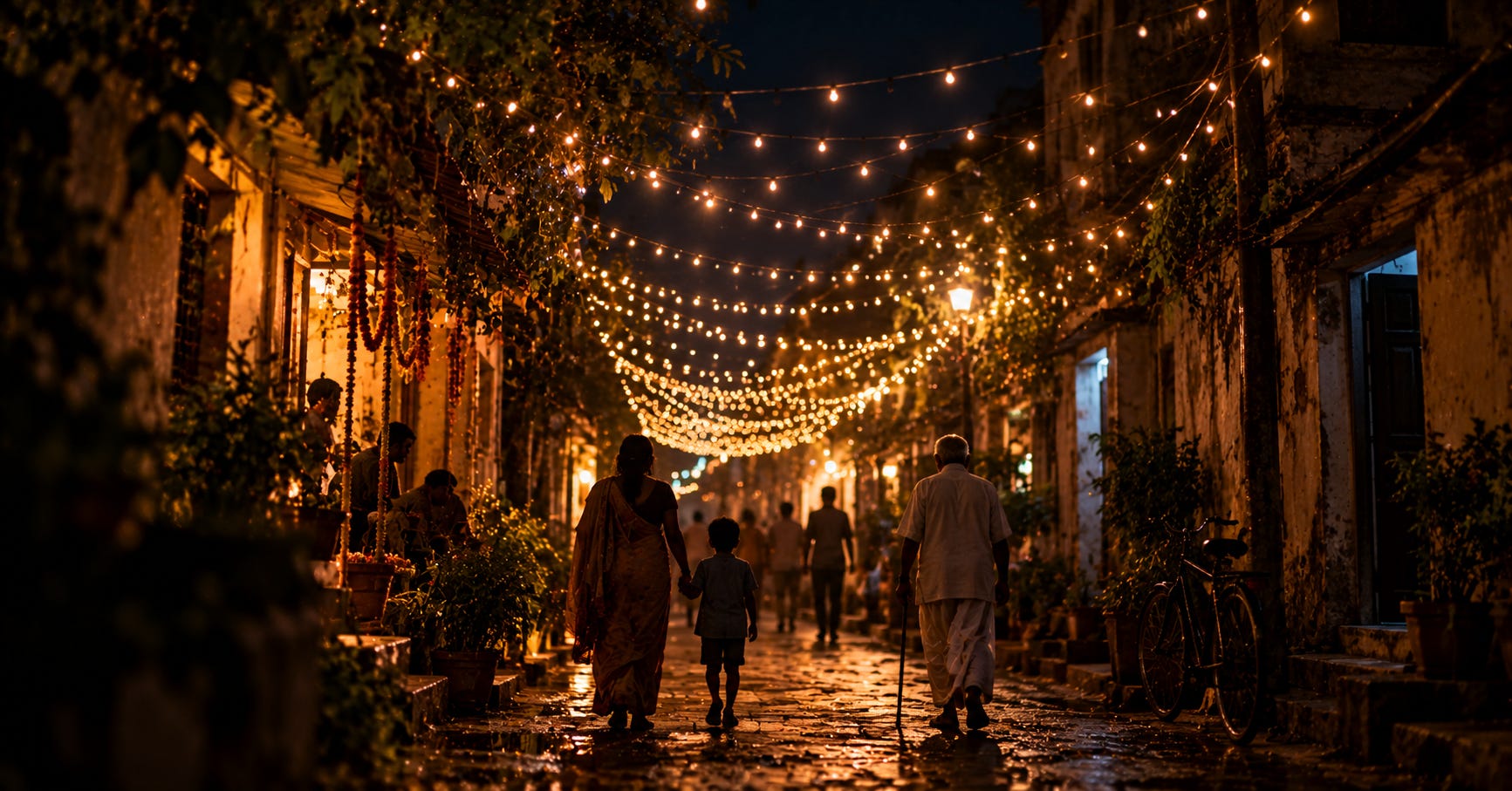
In isolation, a single bulb on that wire illuminates almost nothing. Its glass is paper-thin; its connecting wire is barely thicker than a thread; its pale glow reaches scarcely a few inches before dissolving into the gloom.
Yet strung together, the relationship between those filaments changes what is possible.
A canopy depends entirely on connection. Each small light belongs to a larger arrangement. None illuminates the entire street, but together they make the passage possible.
They do not conquer the night. The sky above them remains as vast, cold, and impenetrable as it was before the switch was thrown. But beneath that canopy, the street is transformed. The uneven stones, the mud puddles, the broken steps, and the stray hazards of the path are suddenly visible. A mother holding a child’s hand can step forward without stumbling. An old man with a walking stick can find his balance. Strangers walk together under a warm, amber shelter, talking in low voices, shielded from the crushing infinity of the dark sky above.
This is the physics of genuine shelter.
Human goodness is rarely an isolated, monumental virtue enacted by a single heroic figure; it is something we construct collectively. A canopy of small lights does not exist to call attention to itself; it exists to make the road passable for travellers. It suggests that a meaningful life is not built by generating blinding personal brilliance, but by adding one steady, reliable filament to the shared wire, contributing just enough quiet warmth so that the person walking beside you does not have to navigate the rough stones in absolute blindness.
Making Bearable
Notice the exact, unpretentious discipline of the word: bearable.
To make darkness bearable is not to claim that we can banish it. It does not promise that we possess the divine power to cure the human condition, eliminate grief, or construct an existence where sorrow is impossible. To make such claims is to indulge in sentimental arrogance.
To make darkness bearable is a far humbler, and far braver, ambition.
It is an admission of our finite limits. It recognises that when a friend’s parent dies, no sentence we utter will resurrect the dead or dissolve the grief. But to sit on their floor for four hours without checking a phone, to boil water for tea when their kitchen has gone cold, to listen to the same broken sentence repeated ten times without offering a shallow platitude - that does not fix the tragedy, but it prevents the tragedy from turning into solitary exile. It takes an agony that was too heavy for one pair of shoulders and distributes the weight across two.
Consider the quiet acts that keep human civilisation from collapsing under the weight of its own fragility:
The hospice nurse who adjusts a thin cotton sheet over the trembling feet of an elderly patient who will not survive the night, speaking in a low, gentle voice even when the patient can no longer answer.
The colleague who steps forward to take on the operational load of a grieving co-worker, ensuring the work is done without demanding public recognition for the intervention.
The neighbour who notices an elderly woman struggling to carry groceries up rain-slicked steps and takes the handle without making a speech about charity.
The person who swallows their own rising irritation during an argument, choosing patience over a cutting, clever retort, simply because they recognise that the other person is fighting a private panic they cannot name.
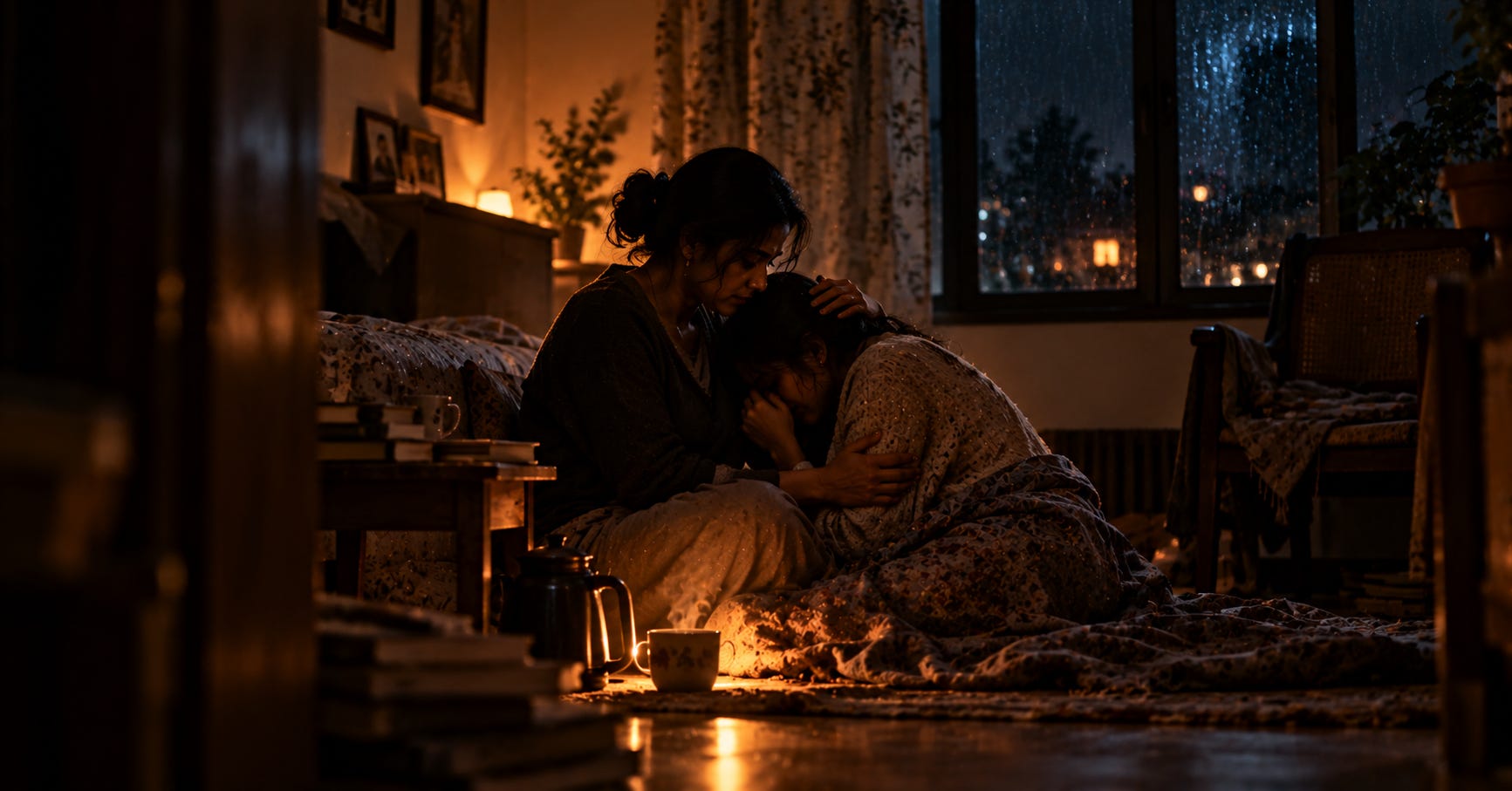
None of these actions attracts a spotlight. They do not trend on social networks. They are not recorded on bronze plaques or cited in biographies. They are performed in the quiet, dusty corners of life where nobody is taking photographs.
Yet they represent an essential ethical achievement: the decision to share the weight of another person’s suffering without surrendering the dignity of one’s own life.
None of this means that a human life must earn its worth through usefulness. A person confined to a hospital bed, unable to lift a hand for anyone else, is no less deserving of love than the nurse who tends to them. The lantern is not a measure of who deserves to exist; it is a metaphor for what we can choose to give when we have something to give.
It is not an invitation to become a silent martyr or an emotional dumping ground for someone else’s unresolved cruelty. There is a profound difference between freely chosen care and coerced self-destruction. A lantern is not the sun. It was never meant to illuminate every road, nor to burn itself to destruction attempting to do so.
Its fuel is finite. A person who exhausts their own reservoir in an attempt to abolish the world’s night ends up cracked, empty, and cold. The wisdom of the lantern lies in offering what light it can to the space directly before it, without pretending its supply is boundless or its boundaries unnecessary.
Where the Light Falls
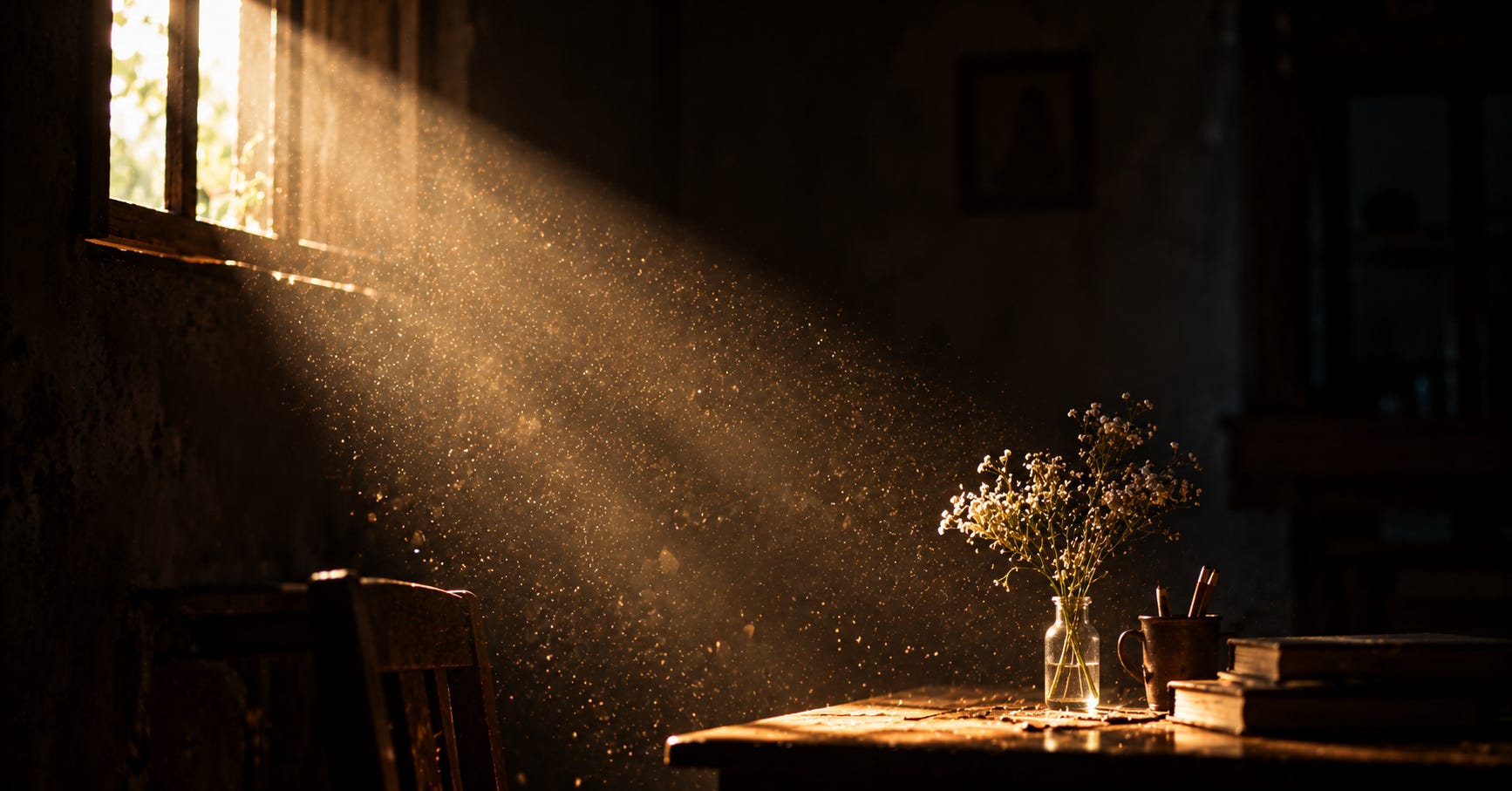
A beam of light crossing an empty void may remain invisible to anyone looking across its path. It becomes visible when it encounters matter - when it scatters across dust motes, catches the rough bark of a roadside tree, or illuminates the contours of a human face.
There is something similar in the ethical life.
We do not live merely to burn for our own gratification. The measure of a life was never how long we managed to keep our own flame flickering, nor how high our sparks flew into the night before dying out. To spend a lifetime obsessing over one’s own luminescence is to end up like a mirror locked inside an empty cabinet - capable of reflection, yet entirely blind and sterile in the dark.
The real grace of existence is found where the light falls: in how much of our finite, fragile vitality was spent softening the impact of an indifferent world upon the people who shared our road.
We will not outlast the night. The expanse that surrounds our brief, fragile lives is ancient, immense, and ultimately indifferent to our arrival. Our bodies will fail, our work will be revised or forgotten, and our names will eventually slip beneath the surface of memory.
Yet while the breath is still in our lungs, we hold a quiet, sovereign choice. We can spend our days demanding that the world turn its spotlights upon us, or we can choose to be the lantern. We can choose to be that modest, connected filament on the wire that hums against the cold… illuminating just enough of the mud, the stones, and the threshold so that someone else can find their footing, take another breath, and keep walking through the dark.
It is really very good!