

Author’s Note
This article is an exercise in political philosophy and civic analysis. Its concern is not with the motives of any particular party, government, candidate, or electorate, but with a broader democratic question: what do governments owe the people who remember their promises, and what do voters owe themselves when they choose what to remember? The examples that follow are intended to examine systems, incentives, and human behaviour - not to assign virtue or guilt to any political formation.
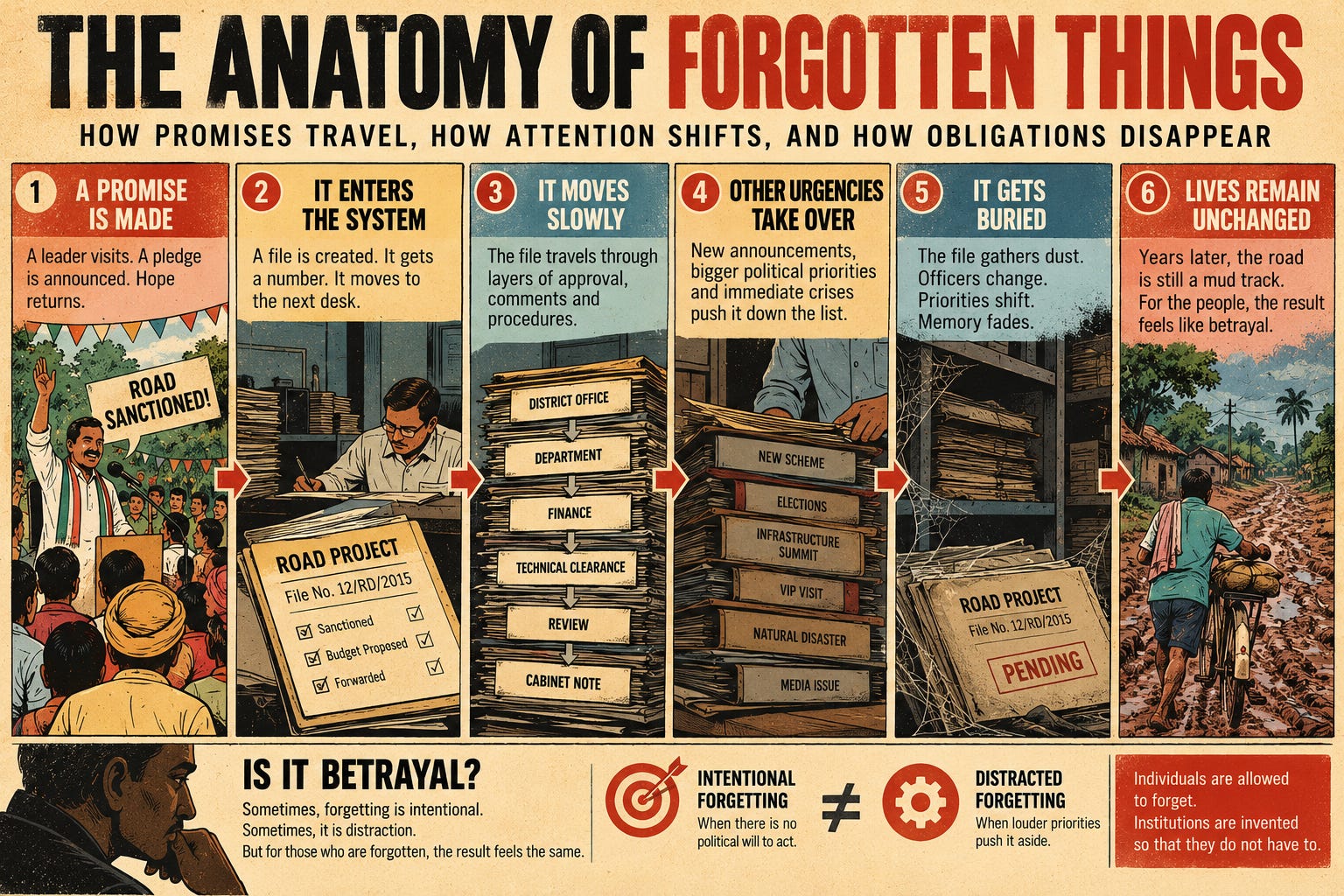
The Anatomy of Forgotten Things
Let us speak frankly for a moment. Put aside the pious civics textbooks, the moralising editorial pages, and the grand speeches delivered from flower-draped stages. Let us look at memory for what it truly is in the exercise of human power: not a holy archive preserved in marble, but a fluid, highly negotiable commodity.
Is forgetting a form of betrayal?
It is a quiet, haunting question. On the surface, our moral instinct answers with an immediate, emphatic yes. To forget a promise made in private or a pledge delivered in public feels like an act of fundamental infidelity. When a person forgets a friend who sustained them in lean years, we call them ungrateful. When a nation forgets the veterans who bled on its borders, we call it dishonourable. And when a government forgets a quiet, tucked-away sector of its population… a district where the river overflows every monsoon, a colony of weavers whose looms have gone silent, a generation of educated youth standing outside employment exchanges - we call it betrayal.
We usually imagine betrayal as intentional: a conscious, calculated turning away from a covenant. But public life complicates that clean definition. In the mechanics of governance, neglect repeated long enough becomes completely indistinguishable from betrayal to the person living with its consequences.
Consider a small village in the forested interior of eastern India. The rain falls in thick, relentless sheets. A mud track, used by three hundred families to transport their harvest to the nearest market town, has dissolved once again into red slush. A decade ago, a local official stood under an umbrella, surrounded by nodding villagers, and assured them that a paved road was already sanctioned on paper. Five years ago, another politician in a crisp white kurta stopped his convoy briefly, accepted a marigold garland, and reiterated the pledge. Today, the mud remains. The road was never paved.
Did the state betray those three hundred families? Or did those three hundred families simply fade into the vast, ocean-like administrative noise of a state managing ten thousand other mud tracks, dozens of budgetary constraints, and the endless, screaming urgencies of daily survival?
To the farmer carrying his produce on a sloshing bicycle, the distinction is entirely academic. The result is identical: he is stuck in the mud. To him, the state’s silence is the cold, indifferent face of betrayal.
Power does not always betray by malice; it betrays by distraction.
There is, however, an argument frequently offered in defence of executive failure: that human attention is limited, and that administrators are merely human beings operating under finite cognitive bandwidth. But that defence rests on a fragile premise. Individual human beings are constrained by biological memory. Institutions, however, were invented precisely so that those limitations would not become administrative failure.
Individuals are allowed to forget. Institutions are invented precisely so that they do not have to.
A government official may not remember the farmer’s face. But the road proposal has a file number. The budget has a line item. The grievance has an official receipt. Institutional memory exists in files, databases, audits, legislative records, departmental archives, and bureaucratic continuity so that public obligations survive the passing of individual minds.
When an official forgets, it may be human frailty. But what happens when an institution repeatedly buries a documented obligation under three feet of dusty paper tied in red tape?
At what point does administrative distraction cease to be an understandable limitation and transform into institutional betrayal?
Perhaps when the file exists, the authority exists, the resources exist, but the political will to act is continually displaced by louder, more politically rewarding noise.
And yet, power does not operate in a vacuum. If we are to examine political memory honestly, we must recognise that the state does not hold a monopoly on forgetfulness. Governments forget people, yes; but people forget governments too.
Governments forget through bureaucracy. Electorates forget through changing expectations. Immediate need can overwhelm accumulated memory. And sometimes societies choose to set grievances aside because remembering everything would make coexistence impossible.
These are not the same kind of forgetting. Their moral consequences are not the same either.
The moral problem is not that democracies forget. It is that they often forget the wrong things.
To understand how these mechanisms shape the life of a republic, we must look at how they collide in the real world of power, regional ambition, and electronic voting machines.
The Depreciation of Gratitude
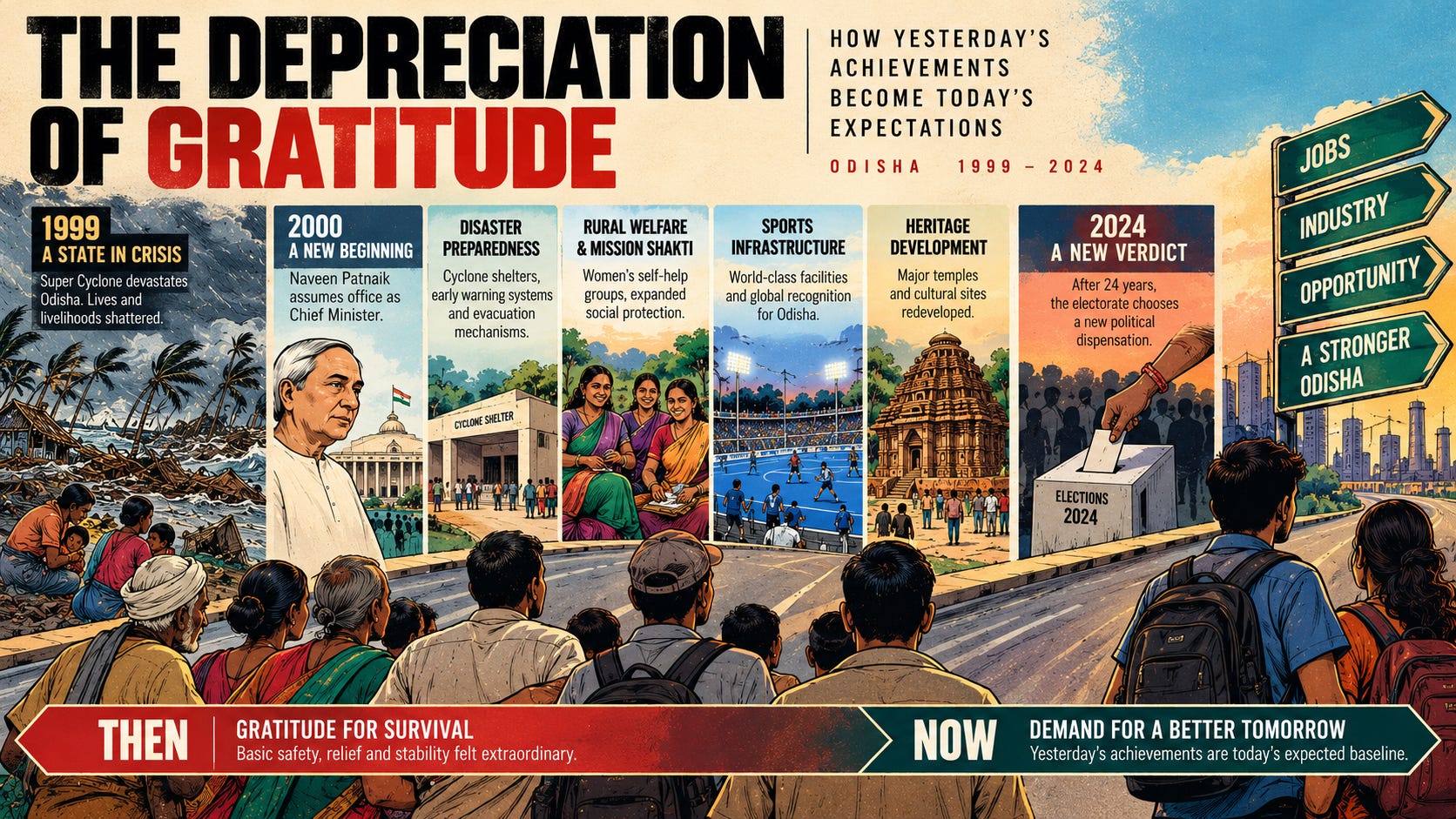
To observe the depreciation of political gratitude in unusually vivid form, one needs only to examine Odisha in the summer of 2024.
For twenty-four years, a quarter of a century, a single political regime occupied the seat of executive power in Bhubaneswar. In the context of modern Indian politics, twenty-four years is an epoch. It is longer than the lifetime of a first-time voter. It is a period long enough for an entire generation to be born, educated, and enter the workforce under a single, iconic leadership.
Following the devastating Super Cyclone of October 1999, Naveen Patnaik assumed office as Chief Minister in March 2000. Over the next two decades, Odisha displayed a degree of electoral continuity unusual in Indian state politics. The state developed a formidable disaster-management architecture that earned international recognition, expanded welfare delivery to the furthest rural corners, built a vast women’s self-help-group network through Mission Shakti, invested heavily in sports infrastructure that turned Bhubaneswar into a regular host of major international sporting events, and undertook major temple and heritage redevelopment projects across the state. None of this meant that the government was without failures, controversies, regional inequalities, administrative opacity, or accumulated dissatisfaction. That is precisely the point.
Decisive verdicts were delivered election after election. The story of stability, quiet dignity, and steady administration appeared immovable, almost permanent.
And then came June 2024.
With a quiet, decisive verdict delivered through electronic voting machines, the electorate ended that twenty-four-year tenure, sweeping the long-standing ruling party out of executive power and installing a new political dispensation.
Post-election commentary in television studios naturally rushed to offer sweeping, monocausal theories. Yet elections involving millions of voters cannot honestly be reduced to a single motive. Anti-incumbency, party organisation, leadership dynamics, regional identity, the public prominence of key political and administrative figures, succession uncertainty, candidate selection, national political trends, and local economic anxieties were all advanced as explanations, with their significance varying across voters and regions.
None of this is offered as a complete explanation of the 2024 verdict. What interests us here is narrower and philosophically deeper: the peculiar way in which even genuine achievements lose electoral purchasing power once they become part of ordinary life.
Did the voters of Odisha suddenly erase twenty-four years of disaster preparedness from their minds? Did they forget the cyclone shelters and evacuation systems that protected communities during Phailin and Fani? Did they forget the welfare programmes and social-protection networks that had become embedded in everyday household life?
No. The electorate did not suffer from amnesia. What occurred was a fundamental shift in the societal baseline.
In politics, a major achievement delivered yesterday becomes the taken-for-granted expectation of today. When a government builds a network of storm shelters that saves a coastal district, the population is profoundly grateful. But fifteen years later, surviving a storm is no longer perceived as an extraordinary act of state benevolence; it is perceived as the bare minimum duty of a functional administration. The voter’s eye quietly moves from the shelter that keeps them dry to the absence of a local industrial corridor that offers their college-educated child a career.
The political case for continuity naturally looked backward at where Odisha stood at the turn of the millennium - impoverished, battered by natural disasters, and administratively fragile. A younger electorate increasingly looked forward to where Odisha ought to stand in 2024 - ambitious, industrialised, digitally connected, and assertive on a national scale.
Part of the regime’s difficulty was that its original political narrative had reached the natural limit of what it could deliver. Its governing narrative had been built substantially around the fundamental crisis of survival. A younger electorate was increasingly preoccupied with the far more volatile, forward-looking crisis of aspiration.
Even substantial accomplishments have declining electoral purchasing power because yesterday’s achievement becomes today’s expected baseline.
Gratitude in politics is not a permanent annuity. You cannot collect interest on historical goodwill indefinitely. Every election is a fresh contract, and in that contract, past credit is ruthlessly discounted to purchase future hope.
The Marketplace of Amnesia
If democratic forgetting reflects the natural evolution of societal expectations, transactional memory represents something far more complex and morally ambiguous.
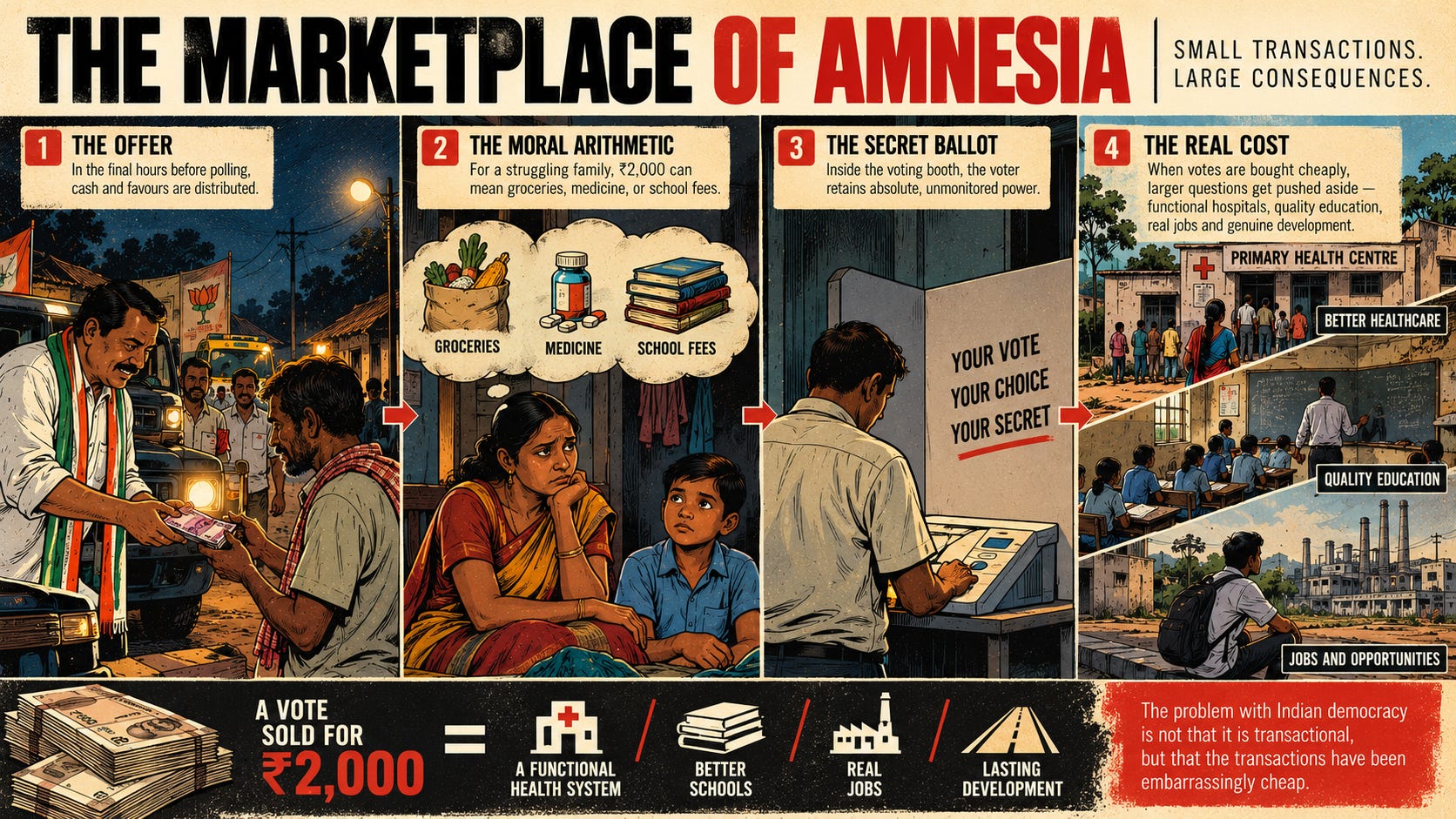
Vote-buying remains a documented feature of elections in parts of India, appearing across regions and political formations in different forms and degrees. In the final hours before polling, when official campaign rallies have quieted, the loudspeakers have been packed away, and the media spotlight has dimmed, informal networks sometimes attempt to distribute direct incentives: crisp cash notes, tokens, or immediate material favours.
It is easy for commentators sitting in comfortable, air-conditioned rooms to deliver sweeping moral lectures on these transactions. From a distance, accepting an electoral inducement is easily condemned as civic degradation, a betrayal of democratic duty.
But such commentary often ignores a fundamental reality: poverty changes the moral arithmetic.
This does not mean that every voter who accepts money is morally equivalent to the political operative who offers it. Power is unequal, and so is desperation. Two thousand rupees means very little to someone writing about democracy from an air-conditioned office; it may mean groceries, urgent medicine for an ailing parent, or school fees for a child to the person standing at the other end of the transaction. Poverty alters the immediate calculation of utility.
Understanding the transaction, however, is not the same as pretending it has no consequence.
What is being discounted in those nocturnal hours before a poll is not an abstract policy scorecard. It is the mother who travelled forty kilometres on a bumpy bus for a basic medical test because the local primary health centre had no doctor. It is the child sitting in a dilapidated classroom where two overworked teachers manage six grades. It is the graduate who discovered that a hard-won degree brought him no closer to a livelihood because no industry ever arrived in his district.
When short-term cash or material tokens overwhelm years of accumulated dissatisfaction with these public services, a subtle bargain takes place.
When we actually sell our vote for two thousand rupees, we cease to be merely victims of the system; we become its equity partners.
A political culture in which such transactions repeatedly succeed teaches the political class that long-term governance, structural reform, and institutional accountability can sometimes be displaced by immediate inducement.
There is, however, one delicious complication in this marketplace: the ballot is secret.
The existence of a secret ballot introduces an element of agency that purely transactional models fail to capture. A voter can accept an inducement from a campaign worker on Friday night and vote according to their true conviction on Saturday morning. The politician attempts to purchase loyalty; the voter accepts the utility; and inside the privacy of the voting booth, the voter retains absolute, unmonitored power.
Who, then, is exploiting whom?
Sometimes the inducement succeeds in shaping the voter’s choice. Other times, the voter quietly extracts material resources from a wealthy campaign machine while intending all along to vote it out of office. The marketplace of amnesia is not a simple story of passive citizens being manipulated by cynical elites; it is a complex, unpredictable arena where both sides attempt to outmaneuver each other.
The deeper distortion of transactional politics is not merely that it exists, but that the terms of the transaction have historically been so remarkably cheap. When democratic bargaining is reduced to small cash distributions or ephemeral hand-outs, the larger, far more valuable transactions - functional hospitals, quality public education, transparent administration, and economic opportunity, are pushed off the table entirely.
The problem with Indian democracy is not that it is transactional, but that the transactions have been embarrassingly cheap.
The Necessary Art of Forgetting
Given the hazards of administrative neglect and transactional short-sightedness, one might conclude that all forgetting in public life is hazardous, that a healthy democracy should strive to remember every grievance, record every failure, and preserve every historical injury in permanent focus.
That conclusion, however, mistakes amnesia for forgiveness.
A society that preserves every historical grievance with absolute, unyielding intensity becomes unalterably paralyzed. If every community nurtured every ancient feud, if every electorate treated every administrative error as an unforgivable offence, and if every political transition resulted in permanent retribution, democratic governance would collapse under the weight of perpetual conflict.
Civilisation does not require amnesia. It requires the ability to remember without converting every memory into an inherited vendetta.
There is a vital distinction between memory, grievance, forgiveness, and amnesia:
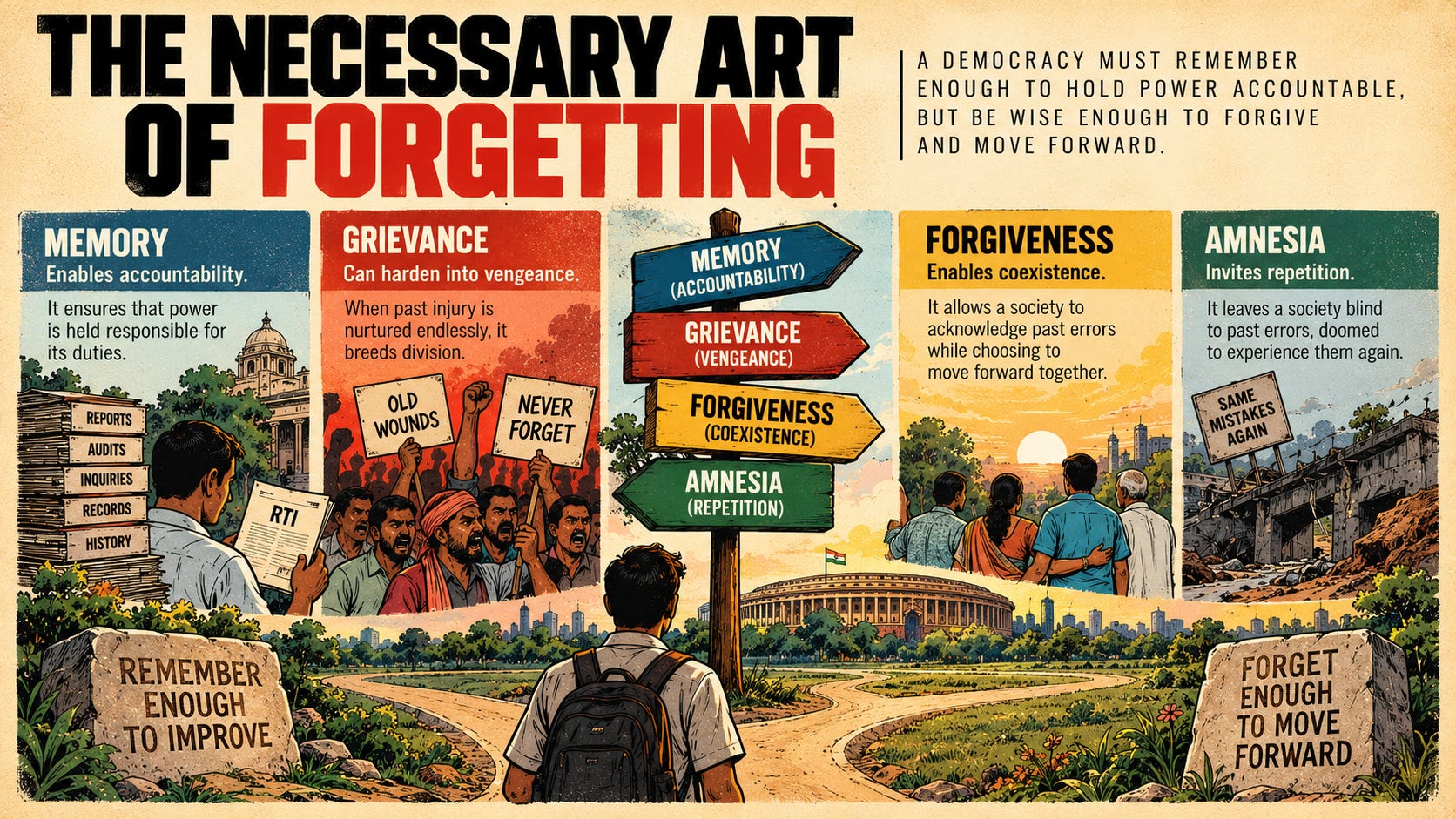
Memory enables accountability - it ensures that power is held responsible for its systemic duties.
Grievance, when permanently cultivated, can harden into vengeance - it converts past injury into permanent division.
Forgiveness enables coexistence - it allows a society to acknowledge past errors while choosing to move forward together.
Amnesia invites repetition - it leaves a society blind to the errors of the past, doomed to experience them again.
A democracy must remember enough to enforce accountability, but possess the maturity to extend forgiveness when circumstances justify it.
When an electorate decides not to punish a government indefinitely for an earlier failure because circumstances have changed, or when a nation chooses to move past a turbulent political chapter to focus on economic development, it has not necessarily forgotten. It may remember perfectly well and simply decide that the memory no longer deserves to govern the present.
That is not amnesia. It is political forgiveness - a deliberate decision to remember without allowing memory to govern the present.
Consider the remarkable resilience of the Indian republic. Despite economic disparities, intense regional diversity, administrative flaws, and fierce political competition, the constitutional framework endures. Electoral power routinely transfers through constitutional means, democratic competition remains vibrant, the reach of public welfare and basic services has expanded substantially, and citizens engage passionately with the democratic process.
The system works often enough to endure, and imperfectly enough to demand constant correction.
Its endurance relies precisely on society’s ability to navigate the boundary between holding power accountable and knowing when to allow the wounds of the past to heal.
The moral challenge of a democracy is not that its citizens forget. The challenge is ensuring they do not confuse necessary political forgiveness with passive surrender, or strategic patience with comfortable amnesia.
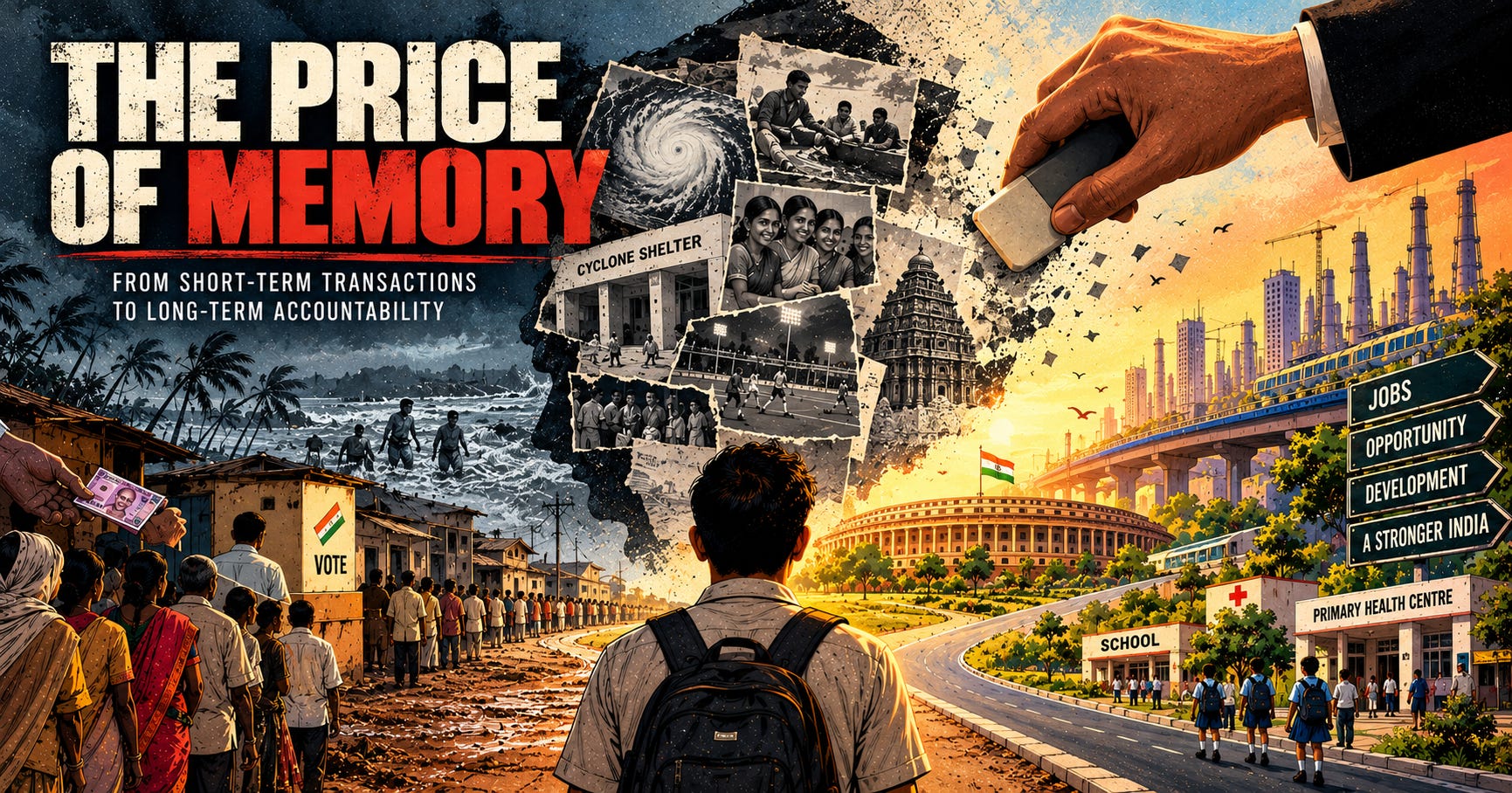
The Price of Memory
How, then, does a republic elevate its political culture? How does it move from cheap, short-term transactions to meaningful, long-term accountability?
Not by delivering grand moral sermons, nor by pretending that voters are helpless victims with no agency of their own. The transformation begins when citizens raise the political price of being forgotten.
Politics, at its core, is a bargain between the governed and those who govern. If that bargain is inevitable in a mass democracy, the objective must be to move from retail politics to institutional politics.
When a voter demands an immediate cash handout, a bottle of liquor, or an individual favour, they are engaging in retail politics. The transaction is small, temporary, and easily exhausted.
When that same voter instead judges political power by whether it delivers a functional primary health centre, a well-staffed school, a paved road connecting their village to major markets, competent local representatives, and an environment that fosters local employment, they are engaging in institutional politics. They are bargaining for assets that endure long after an election cycle has ended.
Nor is institutional politics satisfied merely by concrete and ribbon-cuttings. A hospital building without doctors or diagnostic kits is retail politics wearing institutional clothing. A school without qualified teachers, a factory announced on a billboard but never commissioned, a road inaugurated with fanfare but rendered unusable three monsoons later - these are promises converted into architecture without being converted into outcomes.
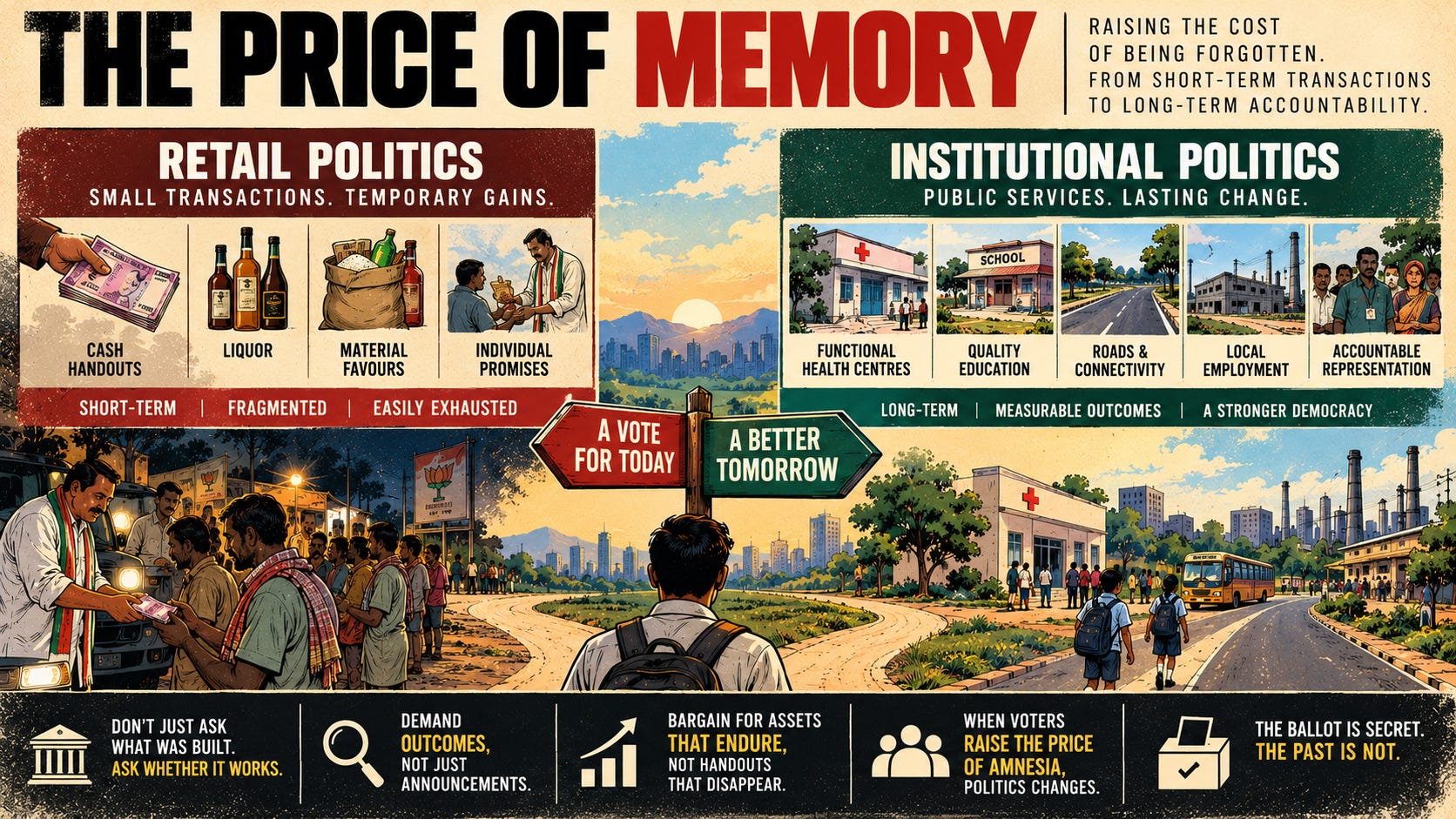
Mature democratic bargaining therefore asks not merely what was built, but whether it works. It demands not merely assets, but measurable performance.
If you are going to bargain with power, at least bargain for something that lasts.
Power begins to take memory seriously when amnesia becomes too expensive to purchase.
When a generation of young voters recognises that a functional local economy and fair access to opportunity are worth far more than any short-term campaign inducement, the dynamics of political strategy will shift accordingly.
Governments will always face competing priorities, and administrators will always operate under finite resources. Political campaigns will always test the limits of persuasion, and voters will always weigh immediate needs against long-term hopes.
Democracy does not ask us to remember everything. No society could survive that burden. It asks something harder: that we know what to release, what to forgive, and what must never be allowed to disappear from the ledger.
Governments will forget. Voters will forgive. Yesterday’s miracles will become tomorrow’s minimum expectations. That is the natural metabolism of democracy.
But there is a difference between forgiveness and surrender, between changing one’s mind and selling one’s memory.
The ballot is secret. The past is not.
And perhaps citizenship begins with knowing the difference.