

The Covenant of Descent
In the foundational mythology of the subcontinent, the descent of the Ganga is rarely depicted as a simple act of obedience.
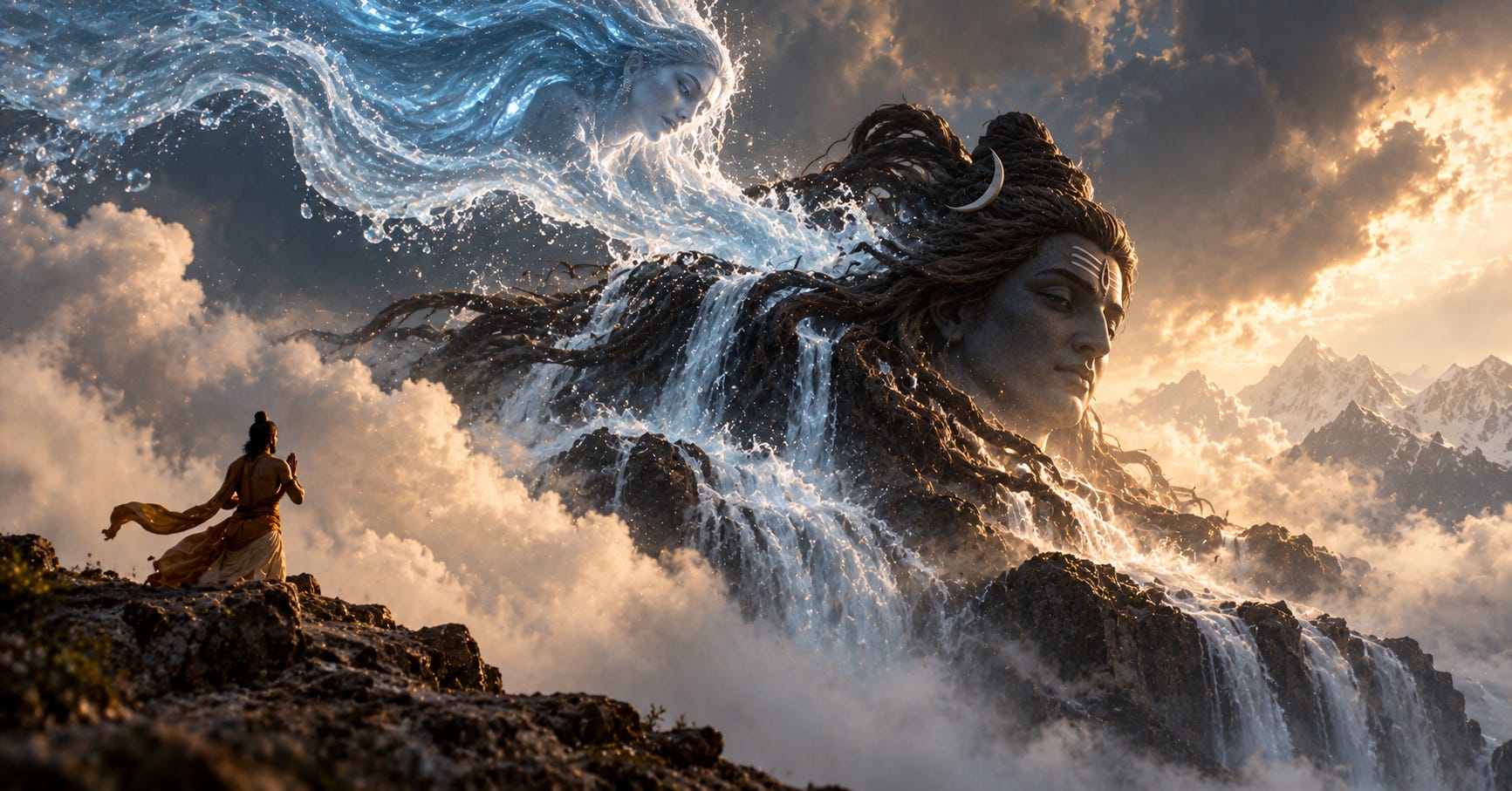
When the penance of Bhagiratha summoned the celestial waters to wash clean the ashes of his sixty thousand ancestors… the sons of Sagara. The story remembers that the river did not descend without reservation. In some traditions surrounding her descent and sacred role, the river herself raises a troubling question: who will cleanse her once the world has deposited its transgressions into her waters? It took the matted locks of Lord Shiva to cushion the violence of her fall, slowing an unbridled torrent into navigable currents across the northern plains.
The narrative tells us how the river came to liberate the dead. It also leaves behind an uncomfortable question: what happens when those who seek purification become the source of her defilement?
Our popular retellings often forget the river’s hesitation, celebrating her arrival while passing over the terms of the covenant. The river was invited down not to inhabit an untouched sanctuary, but to function as an open basin for mortal failure. She came to receive what human beings could neither undo nor carry: the burnt soot of unatoned lives, the residue of crime, and the silent weight of grief.
The materials we once entrusted to the river were largely familiar to the cycles of decay: clay, flowers, wood, and ash. The substances we now send downstream include compounds that do not disappear merely because the current carries them away. Whatever the ancient stories imagined of her powers, the physical river has limits.
The Silt and the Steps
At Dashashwamedh Ghat in Varanasi, the evening conversation between the city and the river begins with brass and camphor.
Priests mount raised wooden platforms set along the bank. Multi-tiered brass lamps are lifted in wide, geometric arcs against the darkening water. Conch shells sound across the stone steps, accompanied by the rapid, metallic beat of bells and hand-turned gongs. Small terracotta bowls filled with oil and ringed with flower petals are lowered into the stream, drifting out into the water like floating embers.
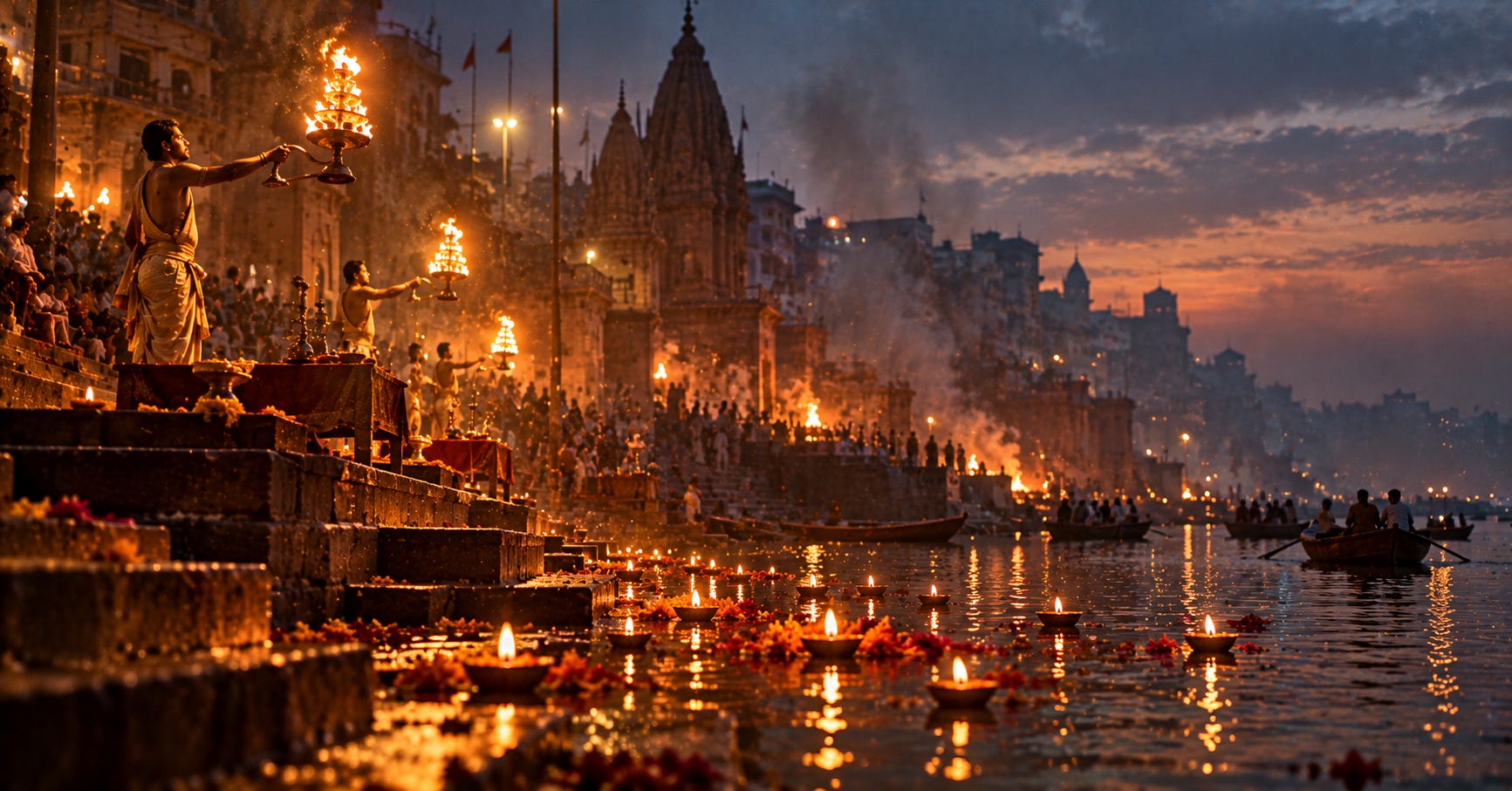
It is an elaborate act of devotion, impossible to look away from.
Yet beneath the wooden platforms, the physical reality of the river is unadorned. The sandstone steps have been rebuilt, repaired, submerged by seasonal monsoons, coated in thick silt, and rebuilt again across centuries. The river has no obligation to remember which ruler or merchant paid for them. It treats the oldest bastion and the newest patch of grey masonry with the same slow, abrasive friction.
The river does not keep our names, nor does it register our pageantry. It simply receives whatever falls into it.
Further along the crescent of the bank, at Manikarnika, the nature of that reception changes. There are no brass bells here, only the dry crackle of burning sal wood, the smell of smoke, and the quiet movement of bamboo stretchers carried down through the lanes. A shrouded body is dipped into the water for a final ablution; later, when the pyre has spent its timber, the remaining embers and bone fragments are swept from the stone into the dark current.
For a few moments, a cloud of grey ash turns the water opaque. A wooden oar cuts through the plume, the river turns in its bed, and the sediment disappears downstream into the silt.
A bystander watching from the steps might turn this into an easy meditation on the insignificance of mortal grief. But the grief of the family climbing back up the alley is not light. To the person walking away, the loss is total; to the water moving past Kashi, it is simply matter returning to matter. The river does not console. It does not perform sympathy. It only offers an exit.
The Convenience of the Sacred
The most revealing encounter with the river does not take place at the cremation fires. It happens during the ordinary daylight between ceremonies.
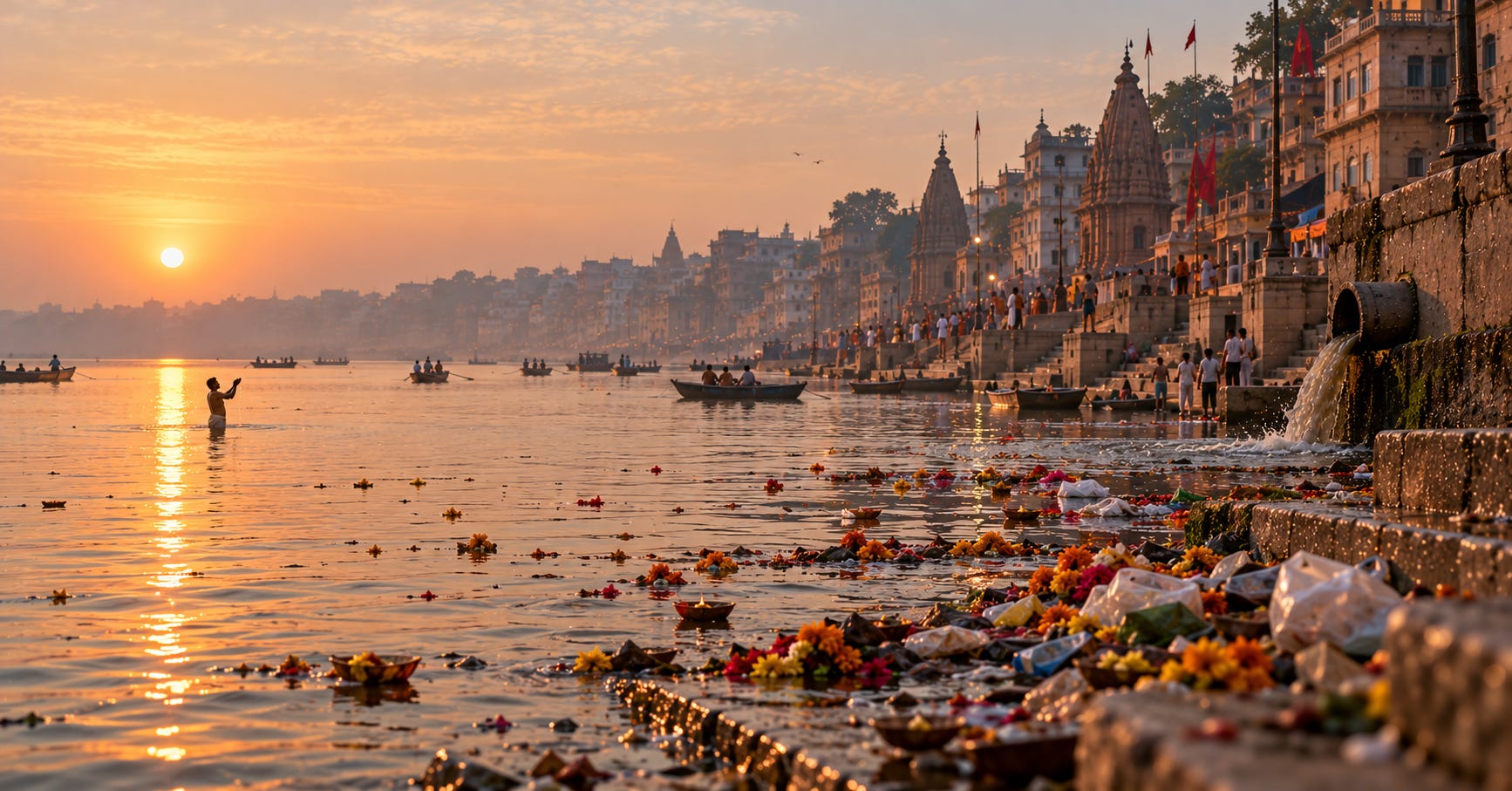
A morning bather stands chest-deep in the water. He cups the brownish fluid in his palms, raises his arms toward the sun, murmurs a prayer, and lets the water spill back into the current in an ancient gesture of reverence.
A short distance away along the same stone bank, an open municipal drain discharges murky, untreated domestic wastewater into the flow. The bather does not look at the outlet. He does not turn his gaze toward the refuse gathering around the hull of a nearby boat, where a plastic bag of decayed offerings has caught against the rotting wood.
The danger begins when we confuse spiritual purity with physical invulnerability. The belief that a river can cleanse the soul does not mean its water can absorb unlimited sewage. Yet it is remarkably easy to preserve the language of reverence while surrendering the work of protection.
Calling the river Ganga Ma does not, by itself, clean her water. The danger lies in treating her sacredness as a guarantee that no human action can diminish her. By declaring her sacred nature indestructible, we grant ourselves a quiet exemption from restraint. If her power to absolve is limitless, then no volume of filth can diminish her; if she is an immortal mother, she is presumed capable of swallowing our neglect indefinitely. Reverence becomes a substitute for sanitation.
There is a familiar human pattern here. We routinely assign the virtues of boundless patience and endurance to that which we intend to exhaust. We praise the selflessness of the soil, the endless reserves of the forest, or the uncomplaining sacrifice demanded of those who manage the burdens of a household… turning their tolerance into a moral duty so we need not examine the weight we place upon them.
We mistake something’s inability to refuse for an invitation to continue demanding.
The Price of Convenience
It is easy to look at the discarded plastic or the wilted garlands along the ghats and place the blame entirely upon the pilgrim. But the degradation of a major river basin is not merely a failure of individual conscience.
The crisis is structural, produced by economic and administrative convenience. It is produced by untreated municipal sewage entering the river through urban drains; by industrial effluents that escape effective treatment; by agricultural runoff carrying fertilisers and pesticides; and by dams and diversions that alter the river’s natural flow. These pressures do not arise from a single source, nor can they be removed by a single ceremonial campaign.
Between municipal bodies that defer maintenance and enterprises that circumvent regulations, the water carries the burden because disposal downstream is cheap. It is far less costly to let the river convey waste toward the sea than it is to build, power, and maintain the infrastructure required to intercept it.
Yet water possesses no mechanism of refusal. A river cannot protest its intake pipes; it cannot stage a walkout or demand a revised agreement. It obeys only fluid mechanics and gravity. What enters its waters may travel downstream, settle into sediment, accumulate in living organisms, or remain long after the current has moved on.
What we see along the river is not an absence of faith, but the consequence of faith stripped of accountability. We have created a culture in which millions can revere a river while the machinery of daily life steadily pollutes it.
What the River Cannot Refuse
At the edge of the ghat, as the bells fall silent and the crowds begin to disperse into the lanes, a woman lowers a small leaf-boat into the water.
The lamp inside it is modest… a wick dipped in oil resting in a small terracotta cup, bordered by a few crushed marigolds. For a moment the flame survives, a trembling point of light holding itself against the dark expanse of the water.
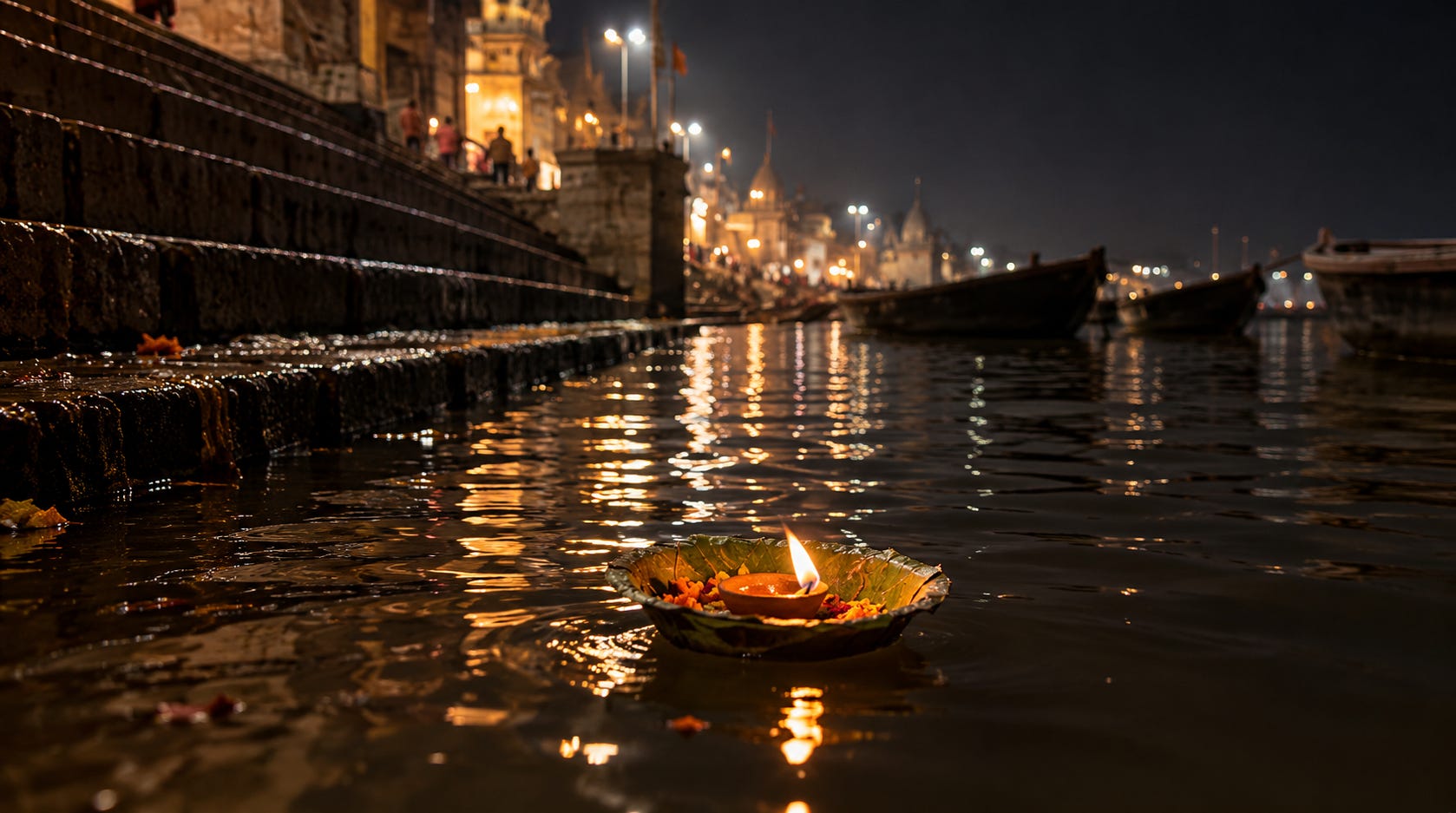
Then the current takes it. It drifts past the wooden platforms, past the moored tourist boats, past the debris trapped against the stone steps, and into the unlit channel beyond the reach of the sodium lights.
Tomorrow the woman may return with another lamp. The steps will be swept, the incense relit, and the family stretchers will arrive at the pyres. Along the length of the bank, the city’s drains will continue their quiet, steady discharge into the water.
The river will continue to receive what we send into it, even as the life within its waters pays the price.
The question is no longer what the Ganga is capable of carrying.
The question is what we are willing to stop placing upon her.
(Author’s Note: The observational vignettes along the riverfront are presented as literary reconstructions - meditations drawn from the familiar rhythms and ritual landscape of Varanasi rather than documented reportage.)
Wow. I really did not ever read about the ganges in such depth. Thank you so much for writing this. Loved every bit of it.
Thank you so much 💕